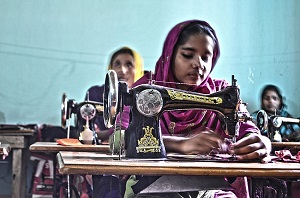
"THIRD WORLD" SUPPLIERS CHARTER - A New Project of The Fairtrade Foundation

  Companies are operating in a changing world, and the expectations of consumers and other stakeholders are becoming more challenging. A new project of the Fairtrade Foundation aims to encourage and facilitate the development of corporate policy and practice to address growing concerns about the social and employment conditions of workers in the developing countries. Many industries and individual companies are now developing codes of practice in this area; a welcome and very positive move. How ever, such codes must be meaningful and rigorously applied to gain the confidence of customers, staff and investors. There is a need for development work in a number of areas if companies are to make substantial progress in this area.

Information: This is a complex field and companies may have suppliers in several different countries and sectors. There is a need for information about the legal framework and the situation on the ground in order to in form corporate decision-making and prioritization.
Standards: Similarly, faced with widely different employment standards in different countries, companies need a widely-accepted defini tion of good practice against which they can begin to evaluate their own supplier base.
Action: Companies faced with social and employment problems emerging in their supply chain are often expected to take quick action, while they know that disruption may badly affect the people most closely involved: the producers. Along with clear and defensible prioritization, companies need support in making a longer term and more effective re sponse, in partnership with long term suppliers.
Procedures: Monitoring third world suppliers, evaluating performance and developing a response within the context of a business demands the development of procedures that minimize resource reallocation and fit in with existing management structures. Sharing of experience - the transfer of effective practice - will assist further development of the process.
Project aims: The Fairtrade Foundation is launching a project to encourage and facilitate companies to develop effective codes of practice with respect to their third world suppliers.
  The project aims to:

  The specific objectives of the project are: The project: The Fairtrade Foundation has begun to work with a small number of companies on the development of codes of practice reflecting the principles already developed in its existing fair trade marking work.
  While initial indications are that interest may be widespread, in the first three years the Foundation will focus on a pilot program with companies in different sectors in order to establish procedures. The experience will then be analyzed and published. The work will be in part funded by grants, but companies will be expected to pay consultancy fees.
  The work will be developed in three phases:
Advisory/consultancy work: This will be undertaken by staff of the Fairtrade Foundation, and will be based on detailed consultations with labor and non-governmental organizations in the producer countries, from whom specific research will be commissioned. This will aim to identify problems specific to the countries and sectors in which the company is engaged, and to offer the company advice on policy development and presentation, appropriate data-gathering and verification systems. The Foundation can also provide seminars for buyers/quality controllers or oth er staff involved in the implementation program. The work will contribute to the development of company Codes of Practice and a detailed implementation program. To underpin this work a database of national and international laws, conventions and standards for employment and working conditions will be built up over the first year. Once a robust system is in place, and under a further contract with a company, the second phase may begin:
Annual audit: This will be under taken in a confidential manner according to Fairtrade Foundation standards and procedures. The aim is to assess how effectively companies are implementing their codes of practice. The Foundation's aim is not to assess individual suppliers, but to evaluate the companies' own procedures to detect and address problems in conjunction with their suppliers. Information about individual suppliers would remain confidential. Producer country consultants will be used where considered appropriate, and over the period of the project may play key roles in background briefing and monitoring. Initially the audit is also important in order to evaluate the effectiveness of this project itself.
  Once a reliable evaluation system is in place, and if the company is in a position to do so, the program can progress to the third phase.
Public declaration: On the basis of the audit of the implementation program, the Fairtrade Foundation and the company may agree to a joint statement to be presented to customers, shareholders, suppliers or other stakeholders. This information could provide a focus for proactive media engagement coordinated between the Foundation and the company con cerned. During the life of the project a publicly-launched Charter will be developed in order to provide a focus for the concerns of NGOs and stake holders.
  In the long term, this element is important to spread awareness of the importance of effective codes of practice, both amongst consumers and the business community. It is also intended to increase consumer confidence in companies actions to improve the social conditions under which its products are made.

Principles

  The values underlying this work are of prime importance. It is the Foundation's view that any policy or code of practice work should be founded on the following shared principles:
Corporate responsibility: Retail ers and manufacturers accept their share of responsibility for the social and employment conditions under which their products are made. Where this responsibility is trans ferred to a supplier, the retailer or manufacturer retains responsibility for verification and assurance.
Effective action: Procedures are in place in the event of problems being detected. These will provide for the positive involvement of trading part ners in solving problems. Withholding business should be a final resort. These actions apply both to contractors who fail to meet standards, and to manufacturers or retailers who fail adequately to monitor and enforce standards.
Broadly accepted standards: Any Code is only as effective as the stan dards of employment enforced, and of the monitoring process. Where international standards exist (such as ILO conventions and recommendations), these are built into the pro cess. Other standards accepted by the stakeholders directly involved should be developed in a transparent way.
Developing application: As priorities concerning employment and so cial issues generally change and new issues of concern emerge, Codes of Practice and standards are also ex pected to evolve, with the participa tion of all the stakeholders.
Independent monitoring: For consumers in particular to have confidence in a code of practice in this area, its implementation will be de veloped with and monitored by a trusted independent body. Decisions taken under such a policy are not always easy to communicate to the public - and the media - and it will become increasingly important for companies to have an independent voice in support.
Worker perspective: Many countries' laws require the participation of workers in the application of proper standards of health and safety; the same principle holds also for other employment issues. Care is taken to ensure that the perspectives of the workforce and/or organizations able to represent their views are taken into account in the development of standards appropriate to local situations, and in the verification process. In this sensitive area, the Foundation, through its partners in the third world producing countries, can ensure such input in ways that minimize the potential difficulties.
A code of practice: Any company code of practice should meet the concerns of stakeholders, especially producers in the third world. Codes developed in the context of this project would be expected to have a number of components.
A statement of principles: Within the context of the statement of fundamental principles above, codes of practice should be based on a compatible statement. The following principles are an example:
- All companies in the trading chain should do their best to ensure that the conditions of work and employment are in keeping with the fundamental dignity of human beings;
- The economic benefits of the trade should be shared equitably in order to ensure a decent living standard for people involved;
- Standards of health and safety and environmental protection should be enforced to protect workers and local communities from harm;
- Workers should be consulted in decisions affecting their welfare.
Minimum standards: Suppliers are expected to meet minimum standards for a range of employment conditions based on International Labor Organisation Conventions. Not all suppliers will initially conform with all standards but the implementation program will in a measured way in crease the degree of conformity in a reasonable time.
Details are given in the Appendix, but the standards cover the following issues:
Monitoring: The extent to which suppliers meet these standards is monitored by the company or by its agents. This monitoring includes di rect visits to production sites and dis cussions with representatives of the workers.
Trading relationship: The rela tionship between the company and its suppliers should be supportive of high social and employment stan dards. Development plans are agreed between the company and its suppliers in the context of an on-going relationship.
Supplier selection: Where a particular supplier is unable or unwilling to make reasonable progress towards meeting the standards, particularly where equivalent suppliers do, this should be a major factor in determining whether a trading relationship should continue.
Subcontractors: Where production is carried out by producers subcontracted by the direct supplier, the same standards and monitoring procedures are also enforced.
Audit terms: The detailed terms of audit are to be developed as part of the initial program. However, a number of key elements are likely to be part of any adequate implementation of a Code of Practice.
Policy: A written company sourcing policy should be developed, consistent with the Principles above.
Resources: Board responsibility for the program should be invested in one person; adequate resources should be made available; a senior manager should be given responsibil ity for the program; buyers/quality controllers should be given clear responsibilities; staff training should be undertaken.
Procedures: A list should be maintained of suppliers approved for use; a prioritized and timetabled implementation plan developed; specific implementation and improvement targets set; internal evaluation procedures in place; evaluation carried out by the company or on its behalf; a properly resourced program to review and address problems detected by the evaluation; verification mechanisms in place; appropriate actions and sanctions undertaken in the case of failure; suppliers required to adopt a similar procedure for their subcontractors and suppliers.
Information: Suppliers should be told of the plan and its aims; appropriate information sought from suppliers and their subcontractors; an implementation handbook produced for staff and suppliers; a written procedure developed for direct or sub contracted checking of suppliers; a written procedure developed for reviewing supplier performance against the policy; relevant procedures should be understood and implemented by staff and suppliers. (by Phil Wells - The Fairtrade Foundation)
home page (3 k) Home page