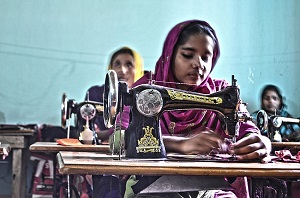
(By Martine Kruijtbosch, India Committee of the Netherlands)
Among the many lucrative export products, one is the carpet. The carpet industry is spinning an annual foreign exchange of Rs 1500 crores ( approx U.S. $ 500 million ) which is coming from the main carpet importing countries as the United States of America, Germany, England and other European countries. The harsh truth why this is a profitable industry, however is because of its cheap labour force spinning the patterns; namely children under the age of 14 years being severely exploited in this industry.
Instead of having a healthy joyous childhood with the basics of primary education, these children are lured into the darkness of the carpet loom units. Chained to the laws of the employer the bonded child labour is too young and mute to raise his voice and just obeys his master. Seperated from their parents, without nutritious food and breaks these children work for 14-16 hours in poorly ventilated workspaces, regularly beaten up because they work not hard enough or ask for their parents. The nimble fingers spin the carpets without seeing daylight without seeing any payment.
As these carpets are exported, the South Asian Coalition on Child Servitude ( SACCS) launched a big Consumers Awareness Campaign in European countries and United States about the inhuman malpractices in the carpet industry. Consumers in these countries were ignorant of how the carpets actually are made. As the consumers and others got deeply concerned about child labour in carpet making, the result was a big drop in the import of these carpets. Public pressure of Germany and other European countries on the issue of child labour in India and other Asian countries is rapidly increasing. The U.S Senators even moved a bill to ban all the products made by children entering into the U.S.
SACCS has the determination to eradicate this form of modern slavery i.e debt bondage and child labour in the carpet industry but is not against the export of carpets or carpet industry. It wants child labour to be replaced with adult labour and advocates affixing labels after scientific and independent inspection & monitoring.
For the last three years SACCS worked out the idea of labelling carpets which are not made by children. This label called the RUGMARK guarantees the buyer/consumer that the carpet is manufactured without child labour. Together with representatives of carpet industry, Indo-German Export Promotion Programme ( IGEP - a trade promotion organisation ), UNICEF. Carpet manufacturers (who do not employ children), NGOs etc. a system was developed named RUGMARK FOUNDATION (RMF). This foundation acts as an international, independent, legal, professional and non-commercial certification & monitoring system to guarantee after random checks at carpet looms by professional experts that not a single child is working in these units. If all the certification criteria are fulfilled by the carpet manufacturers/exporters and loom owners and the inspections carried out by the RUGMARK officials indicate absence of child labour, then the carpet manufacturer/exporter is licensed by the RMF to use the RUGMARK logo for his carpets.
This booklet aims at providing information about the RUGMARK right from the concept upto materialisation of a tangible mechanism to monitor and certify carpets made free of child labour.
Let the RUGMARK be a model and trend-setter for other products also where child labour constituent exists. Because compared to carpet industry in which more than 300,000 children are employed there are other industries also which totally account for about 55 million child labour.
The phenomena of child servitude is almost similar in the South Asian countries. Against such a backdrop, a coalition of like minded NGOs of South Asian countries came into being to wipe out this menace thro' concerted efforts pooling and sharing their resources, experience and expertise.
Mirzapur - Varanasi - Badohi areas of Uttar Pradesh had already acquired the dubious distinction of the biggest child labour belt accounting for about 300, 000 children in carpet manufacture. Though the Government and the industry were unanimous in declaring that there are no child labour in the industry, SACCS and its associates had been freeing thousands of child slaves thro' direct interventions, raids and seeking help of High Courts and Supreme Court. Till date more than 27,000 have been got freed from various economic sectors of which over 7000 alone is from carpet industry. Only recently, the Government and the industry have acknowledged the presence of Child labour in the carpet sector as a result of the campaigns initiated by SACCS and like minded NGOs.
Child Labour still exists in the carpet industry today, because the local bureaucracy is hand in glove with the carpet trade and on several occassions, have virtually placed hurdles in the rescue operation initiated by NGOs. The government even attempts to justify child labour on the grounds of poverty, family labour and learning a trade.
The German importers also applied pressure on Indian carpet exporters to remove child labour from their industry or face boycott. Besides, the Government of Germany also took up the issue of child labour with the Indian counterpart. Meanwhile, the Senate of U.S.A witnessed the introduction of a bill initiated by Senator Tom Harkin and Congressman George Brown and others seeking ban on imports of all products made by children. The European and German Parliaments are also contemplating to legislate on the same lines.
SACCS never advocated for the total boycott of goods. It suggested the buyers to look for products made by adults. Its contention was why children are made to labour destroying their health, growth and childhood when millions of adults are jobless? Removing child labour means opening up of millions of job opportunities for adults. The children should be sent to schools instead of workplaces, books and toys should be in their hands and not sharp and dangerous working tools.
In the meanwhile, SACCS continued its efforts to develop further the labelling and monitoring system of carpets made by children. It kept on demanding before the United Nations Human Rights Commission (Sub Group on Contemporary Form of Slavery), Geneva that needful steps be taken to ban trade on child made goods and also adopt a labelling system to facilitate the consumer to confirm that a particular product is not child made. In 1991, UNHRC welcomed the demand of SACCS and recommended it in its report as under:
1991/119.
* Recommends that products such as carpets whose manufacture is liable to involve child labour should bear a special mark guaranteeing that they have not been produced by children. In this context consumers should be alerted so that they will demand products bearing such a mark.
SACCS emphasised that this monitoring & labelling system as mentioned above should be independent, non-commercial, professional and international. Because the very important question that arose among the consumers with reference to carpet labels was " Who could fix the labels? To make it credible and reliable, who would inspect the carpet loom units"?
The consumers will have no faith if the labels for the carpets are fixed by manufacturers and exporters themselves. Similarly, they cannot place faith on a label issued by a government agency. NGOs too are not in position to carry out extensive inspections and conduct processing of labelling. Also, SACCS disagreed with the clause in the Tom Harkin bill that self certification by importers that the carpets are free of child labour, will make the carpets eligible for import. When Mr Kailash Satyarthi pointed out this flaw, the Senator complied and amended the bill.
As reliability, credibility and international authenticity of a monitoring and labelling agency was such an important matter, SACCS discussed on this thoroughly in a working committee attended by many an international organisation, legal experts and professionals. In the succeeding meetings of the working committee held during 1991-1994, some concrete steps were initiated in collaboration with Indo-German Export Promotion Programme (IGEP), other NGOs, carpet manufacturers exporters, CMACWCL and importers.
IGEP not only agreed to participate in formulation of such an agency but also took responsibility to frame a professional system for inspection and labelling consistent with international standards and requirements. The system was named "RUGMARK Foundation (RMF) and the label RUGMARK."
Some major carpet exporters did not want to participate in the RUGMARK Foundation as they were affraid that the latter will jeopardise their interests. IGEP who took lead in the process of formulation of RMF wanted the whole thing to be completed before the end of 1993. One of the reasons for this was that the famous DOMOTEX fair held in Germany where some of the finest carpets with RUGMARK logo could be presented. According to IGEP, the RUGMARK initiative would loose its credibility among the traders and the public if the introduction of the logo is delayed any further.
A Board of Directors was constituted with the representatives of carpet manufacturers and exporters in India, representatives of NGOs, Indo-German Export Promotion Programme (IGEP) and UNICEF.
The RMF is a non-commercial, independent, international and professional body with legal power to verify, inspect, monitor and subsequently affix a trade mark label, that is RUGMARK logo to the carpets which are not made by children. The RUGMARK label provides the importers & consumers a visual guarantee that these carpets are manufactured without child labour.
The certification system, inspection criteria and labelling system are shaped and calculated in a way that requirements can simply be fulfilled by the carpet manufacturers exporters and loom owners. Cost for the inspection of the loom units and the certification has been minimised to bearable level to the carpet trade.
The RUGMARK will go a long way in helping the carpet industry from facing any import ban. The close and trusting co-operation of NGOs, international development agencies, carpet importers and IGEP with the Indian carpet manufacturers reduces child abuse in this industry to a large extent.
RM, hopefully, will contribute towards rise in the exports of carpets made free of child labour and assure a regular inflow of the badly needed foreign exchange into India. Also it will be instrumental in eradicating child labour in the carpet industry, provide employment to adults, reverse the negative image that is presently projected on Indian carpets abroad.
Finally RMF decides on the right to use the RUGMARK logo lt examines all applicants for membership in detail according to all the RMF requirements and inspection modalities which can be seen in the next chapter.
The brief history of RMFwill hopefully give a better understanding as to how the RMF was developed and why it was so important that it is legally formalised. Export of carpets can continue but not on the heavy cost of ruining future generations as adults can now enter the vacant jobs in the carpet industry.
Main concern of SACCS is the rehabilitation of the freed children as more carpet manufacturers decide to let their carpets be manufactured by adults and not children. The RM will involve itself narrowly in programmes for rehabilitation.
The cardinal criterion is that the manufacturer/exporter should employ only adult labour for the manufacture of his product. His workplace will be liable for inspections at any time. He/the firm will apply to RUGMARK Foundation along with the fees for issue of licence. Once the foundation is satisfied that the applicant has fulfilled all the required conditions after inspections and scrutiny, a licence agreement is made out and this would hold legally. After obtaining the licence the manufacturer/exporter is free to use the RUGMARK label in his carpets. There would be regular and frequent inspections to ensure that child labour is not used by him.
The certification criteria covers:
Apart from the above, the applicant desirous of RUGMARK licence shall fulfil the following conditions:
In addition, the NGOs attached to the Foundation also carry out random inspections to plug any plausible loopholes. The lists of looms furnished by the carpet manufacturer/exporter should be accorded due confidentiality and the lists should be used only for inspections. The inspection units will be required to return the lists to the Foundation along with the inspection report within a stlpulated period.
The parameters governing the loom inspections cover:
* The findings of the inspecffons will be recorded and documented in a data base which is constantly updated and cane be verified at any time.
* The documentation of the inspection findings must be clear and categorical to facilitate easy tracing back of any loom unit of a particular carpet at any given time.
* The inspection will continue even after the issue of licence to a manufacturer/exporter and violation of the terms and conditions of the agreement would tantamount to cancellation of licence and termination of using RUGMARK labels.
* Every carpet will be assigned an internal RUGMARK code number in the data base to identify the following sources.