by Medea Benjamin of Global Exchange
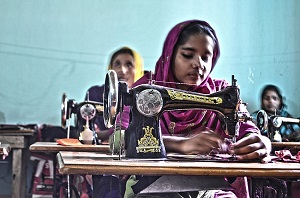
After the exposés in the early 1990s of horrendous conditions in sweatshops producing clothing and shoes for some of the largest US companies, the fight against sweatshops has come a long way. Companies that once refused to acknowledge their responsibility for factory conditions by alleging they were "only the buyers" now have Codes of Conduct, undertake more serious internal monitoring of the factories they buy from, and several companies have begun experimenting with different forms of external monitoring using local human rights groups.
But there is so much more to be done to clean up this industry for throughout the world, garment workers continue to work long hours for below subsistence wages, they continue to get sick from unhealthy work conditions, and they continue to be fired for trying to organize unions.
For the past two years, a group of companies, trade unions, human rights and religious groups, convened by the White House, have been meeting to try to create an association that would set workplace standards for the industry and a means of monitoring compliance with those standards. The unions and several of the human rights groups fought hard to set strict criteria that would truly improve workers' lives, while companies fought to make the standards loose enough that other companies would join the effort-locking the group in a stalemate for the past year.
On November 2 a subgroup announced that they had come to an agreement-an agreement that the two unions (the garment workers' UNITE and the Retail, Wholesale and Department Store Union) and the ecumenical Interfaith Center for Corporate Responsibility refused to sign because of its bias in favor of the companies. A careful reading of the standards and means of enforcement indicate that the FLA is seriously flawed on two fronts:
1. It's standards are too weak to guarantee real improvements in workers' lives
- it allows workers to be paid below poverty wages
- it allows excessive hours of overtime
- it does not adequately uphold the right of workers to organize independent unions
2. It's monitoring system is not transparent nor sufficiently independent of the companies to be credible
- it requires only 10 percent of a company's factories to be monitored yearly the companies can choose their own monitors
- the companies have undue influence in picking which factories will be monitored
- the government and foundations will be called upon to help subsidize the companies' monitoring system
- vague mechanisms for getting input from workers and NGOs
- it keeps important information from the consumer
Despite inadequate standards and monitoring, companies will be able to use their participation in the FLA as a marketing tool. Once certified, they will be able to sew a label into their products saying they were made under fair conditions-a label we feel will fool consumers and will amount to false advertising. For this reason, rather than constituting a step forward as its members contend, the FLA will represent a step backward.
Below is a critique of the FLA as it now stands,
and suggestions for strengthening it so that it can become a useful
tool in the fight against sweatshops.
Fair Labor Association's Standards Will Allow:
Poverty wages: The FLA doesn't acknowledge the responsibility of companies to pay a living wage to factory workers. It only calls for companies to pay the local minimum wage or the prevailing industry wage, both of which are usually woefully inadequate. In Indonesia, Reebok (a founding member of the FLA) pays workers a base wage of $23/month when a recent study commissioned by Global Exchange found that the bare subsistence wage for one person was $35/month. According to the National Labor Committee, Liz Claiborne, another founding FLA member, is paying assembly line workers in El Salvador $134/month, which is just 51% of the cost of the basic basket of essential goods and services for the average Salvadoran family. It is indecent that workers who make clothing and shoes for profitable US companies do not earn enough to feed, clothe and shelter their families in a dignified fashion.
Recognizing its failure to adequately address wages, the FLA will ask the Department of Labor to undertake a study of wages and basic needs data, and will then review the data "to consider their implications, if any" on FLA standards. The Department of Labor will only use publicly available data instead of doing original studies in countries that are major producers for US companies. The problems with compiling only already exisiting data are that there will not be a full data set that covers all producing countries and the data will come from different sources collected using different methods and will therefore be inconsistent. Furthermore, data based on government statistics is often unreliable and even contradictory: you might find finances ministries using one set of data that justifies the setting of a low minimum wage as part of their effort to attract foreign investment, while health ministries will have another set of data that is designed to assess what a person really needs to live a healthy life. As part of the FLA examination of wages, the Department of Labor should do original studies with uniform methods that would gather data in an inbiased way.
As the FLA now stands, however, even if the Department of Labor's limited study were to produce useful information, the FLA makes no commitment to use the data to devise new wage standards. The FLA's position reflects the companies' arguments that a living wage is impossible to define and should therefore be off the agenda.
Challenging this notion that a living wage is impossible to define, a Living Wage Summit for the Garment Industry, organized by Sweatshop Watch and Global Exchange in July 1998, came up with a working definition: a living wage is the 'take home' or 'net' wage, earned during a work week of no more than 48 hours, that provides for the basic needs (housing, energy, nutrition, clothing, health care, education, potable water, child care, transportation and an additional 10% for savings/emergencies) of an average family unit divided by the average number of adult wage earners. The group then developed a formula for calculating the living wage and organizations attending the summit started commissioning studies overseas to test the formula. Preliminary results show the living wage to be about double the minimum or prevailing industry wages. While this might sound like a lot, the wages are presently so low that in most countries, doubling them would still result in labor costs significantly less than 10 percent of the retail price.
The FLA should follow the path of the Living Wage Summit. It should define a living wage, undertake wage studies in producing countries, and make these studies public so that academic institutions, labor and human rights organizations can review them. Then the FLA should come up with a timeline for companies to start paying a living wage. As Rev. David Schilling of the Interfaith Center for Corporate Responsibility said in rejecting the FLA agreement, "A factory may be clean, well organized and monitored, but unless the workers are paid a sustainable living wage, it is still a sweatshop."
Excessive overtime and inadequate overtime compensation: The FLA's Workplace Code of Conduct allows employers, where it is not in violation of local laws, to mandate a six-day, 60-hour work week (48 hours with 12 hours overtime) and even more in the case of "extraordinary business circumstances"-a term that is left undefined. This is totally unacceptable. In the United States, a 40-hour week with weekends off is the accepted norm and laws requiring overtime pay were adopted decades ago to discourage overtime work. In poorer countries, a 48-hour week is often the norm. But in no country should workers be asked to toil 60 hours a week.
The FLA should define a normal work week as a maximum of 48 hours and there should be no mandatory overtime. Factories should meet seasonal increases in production by hiring more workers instead of extending the workday. In terms of "voluntary" overtime, we should be clear that workers rarely want to work overtime; they feel compelled to do so because their wages are so low. If workers were paid a living wage for a 40- to 48-hour week, much "voluntary" overtime would cease.
Compensation for overtime in the FLA's Code is also inadequate. It calls for employees to compensate workers at the legal rate, or where none exists, at a rate at least equal to their regular hourly compensation. Labor unions the world over call for overtime to be paid at a higher rate than the regular hourly wage in order to force employers to respect legally determined limits on hours. The FLA should call for at least time-and-a-half pay for overtime and double time for holidays and the seventh consecutive day of work.
Violation of workers' right to organize: The FLA's Workplace Code acknowledges that workers have the right to freedom of association and collective bargaining, but does not do enough to guarantee that these rights are respected. There are no specific standards for countries such as China and Burma where those rights are denied. There is no overt prohibition against using the local military to keep "order" in the factory and put down strikes, only a recommendation that companies should only contract with factory owners who will not "affirmatively seek the assistance of state authorities to prevent workers from exercising these rights." Interpreting this convoluted statement, UNITE's Alan Howard commented, "This presumably means you can let the army in the factory to put down a strike, as long as you don't pick up the phone to call them."
The FLA should assert that even in countries where the laws and juridical practices fail to guarantee these rights, companies must try to achieve worker representation in their particular factories and must work with the broader labor and human rights community to help create more space for workers' rights. In terms of the former, factory managers should ensure that workers are educated as to their rights, recognize representatives freely chosen by the workers to negotiate terms and conditions of employment and resolve grievances, and refuse to cooperate with acts of state authorities that prevent workers from exercising their right to freedom of association. To verify this, the FLA should require independent monitoring in ALL factories-not just a small sample-in countries where the laws prohibit workers from organizing independent unions.
In terms of helping to open up space for workers rights in the country as a whole, companies should advocate on behalf of jailed political prisoners (especially labor leaders), pressure local governments to pass and enforce laws guaranteeing workers' rights, and give financial support to local human rights/labor rights organizations.
If, despite the companies' best efforts to
ensure workers the right of association, there is no demonstrable
progress, the companies should then be required to abandon these
sites. Otherwise, putting the right to association on the Workplace
Code but failing to enforce it, as it appears the FLA will do,
makes a mockery of this right.
The Fair Labor Association's Monitoring System Will Allow:
An Insubstantial and Biased Sampling of Factories: According to the FLA, a company must submit only 10% of its factories to external monitoring each year for the first three years, and then as little as 5% a year thereafter. This is far too low to be an acceptable indicator of the state of the company's entire production process.
Also disturbing is the fact that the original suggested list of factories to be inspected by independent monitors comes from the companies themselves. While the Executive Director has the power to alter that list, it must be in consultation with the company and "there shall be a general presumption in favor of the Participating Company's suggested list." Given that the companies will know the list of the factories to be monitored, it is logical to assume that they will notify the factory owners. Unannounced inspections-the bedrock of any serious monitoring process-may well be replaced by the all-too-common practice of cleaning up the factory for the monitor's expected visit.
The FLA should call for yearly independent monitoring in 30% of factories, as well as independent monitoring in ALL factories in countries where basic workers' rights are denied. The list of factories to be monitored should be determined by staff experts within the FLA and the monitors, not by the companies.
Biased monitors: The companies can choose their own monitors, provided they are accredited by the FLA. They will most likely choose large auditing firms that they are familiar and comfortable with rather than local non-governmental organizations that have a track record of advocating on behalf of workers' rights. As the Interfaith Center on Corporate Responsibility said in rejecting the agreement, "we are concerned that large auditing firms will become the FLA's 'independent monitors,' marginalizing participation by NGOs who know the local context and are more likely to have the trust of workers."
Moreover, while the FLA pretends to avoid conflicts of interest by saying that monitoring companies cannot perform other services for the company, it is willing to waive this provision upon a "good faith showing" of independence on the part of the monitors. Such willingness to compromise erodes the credibility of external monitoring.
But no matter who the monitors are, they will ALL be compromised by the fact that they will be accountable first and foremost to the company, and only secondarily to the FLA. In this monitoring scheme, the companies will be the clients, and as in any business, a key to success is keeping the clients happy. This does not create the conditions for independence and public accountability. As a State of California health and safety compliance officer told us, "putting the fox's paid consultant in charge of the hen house is not the solution."
To have truly independent monitoring, monitors should be either on the FLA staff or on contract to the FLA, not to the companies themselves.
According to OSHA (the Occupational Safety and Health Administration) standards, the FLA procedures for selecting plants and monitors would be completely unacceptable for any company inside the US and should therefore be unacceptable for US-based companies operating overseas. FLA monitoring contradicts the fundamental basis of monitoring by OSHA, which is unannounced visits targeting the highest hazard factories (as defined by OSHA experts, not the companies) conducted by experts who are not working directly for the companies. The FLA should follow these basic OSHA guidelines.
Corporate welfare for billion-dollar companies: One of the most shocking details in the agreement is the payment scheme. To join the FLA, companies pay a bare bones fee: a sliding scale of $5,000 to $100,000, the top fee being for companies with revenues over $10 billion. So a company like Nike, with a mere $9.6 billion in revenue, will pay less than $100,000 (compare this to the $200 million fee Nike paid to sponsor the Brazilian soccer team). Then for the cost of external monitoring, the first year the companies will be reimbursed 50%, 45% the second year, and 30% the third, at which time they will be weaned from corporate welfare. And if there is a complaint about a particular factory, the executive director of the FLA can call for additional monitoring but "the Association shall reimburse the Participating Company for such additional external monitoring"!
Who will be called on to help these impoverished companies pay for their factory inspections? The FLA will ask the US government for funding, as well as foundations that are supposed to support non-profit organizations-not billion-dollar companies. So it's the perfect scam: the companies profit handsomely from sweatshop labor, and when under pressure from consumers to clean up their mess, they call on taxpayers and foundations to foot the bill!
The FLA should require the companies to pay the full cost of their own monitoring, and to pay a participation fee that is high enough to allow the FLA to be self-sustaining without having to rely on goverment or foundation funds.
Secrecy With Regard to Factories Making their Products: While monitoring is supposed to help lift the veil of secrecy that characterizes garment production today (i.e. lack of knowledge about where and how the products are produced), the FLA system of monitoring entrenches the code of silence and does little to increase public accountability. The monitors' reports don't go to the FLA itself until 60 days after they are submitted to the companies (instead of simultaneously), and the public only gets a standard summary (instead of the entire report).
Moreover, the public does not even have access to the most basic information, i.e. the names and locations of the factories the companies use. There has been a major push within the anti-sweatshop movement to force companies to disclose where their products are made. Right now, even workers rarely know what company is purchasing the products they make. If workers and their advocates knew this information, in cases where local managers are being abusive, they could register complaints directly with the buyers. Moreover, given that independent monitoring will only take place in a minority of a company's factories per year, disclosure of all factory sites could open up the system to receive more input on the status of the non-monitored factories.
Companies argue that information about what factories they use is proprietary, that having high quality factories and keeping this information from their competitors is important for maintaining their competitive advantage. This argument is dubious on several counts: oftentimes competing shoe and apparel companies produce their goods in the same factories as their competitors; most of the information of who is producing what and where is already well known within the industry itself; and contractors themselves disclose who it is they are already working for as part of their sales pitch to prospective clients. The ones who are left in the dark are not the competitors, but the consumers. And if there are indeed cases where disclosing this information would truly decrease a company's competitive advantage, this is simply the price that must be paid for a more transparent, less exploitative system.
The FLA should require companies to make pubic the names and locations of all factories making their products.
Lax enforcement: If a company fails to comply with FLA standards, it can be placed under special review for an indefinite period, without notifying the public. Moving from a special review to actually terminating a company's participation for non-compliance will be difficult. Many FLA decisions, including the decision to certify a company's compliance, will be determined by a simple majority vote of the board (which is composed of 6 industry and 6 NGO reps). However, a decision to terminate a company's participation can only be made by a super majority vote, which is defined as at least two-thirds of all the industry board members and two-thirds of the NGO board members. Clearly this structure favors the companies and will diminish the threat of termination as an incentive for compliance.
The public should be notified when a company is under review, since this information is important to consumers and will increase pressure on the company to comply, and six months should be the maximum duration of the review process. If after six months the company fails to comply, the FLA should be able to terminate the company's participation with a simple majority vote.
Unless the FLA amends its Code of Conduct to address the issues noted above, it will merely be monitoring sweatshop conditions. No monitoring system, no matter how transparent and independent, will substantially improve conditions for garment and shoe workers unless the standards include a living wage and the right to organize.
Given its inadequate standards and monitoring system, the FLA will not just be ineffective, but a step backward. Why?
From the company perspective, the real incentive to join the FLA is to get good PR, or at the very least to try to avoid the bad PR that comes from media exposés of sweatshop conditions. Companies will use the FLA as a "good housekeeping seal" to convince consumers that their products are not made in sweatshops. In fact, just by joining the FLA (before even being certified), a company can advertise the fact that it is part of this effort to eliminate sweatshops.
Once certified, the company can then sew a "FLA certified" label on its products. According to the agreement, a company doesn't even have to be certified as a whole company but can certify a particular brand. So by passing muster in only 10% of the factories of a particular brand, the company will be entitled, for that brand, to "use the service mark of the Association in product labeling, advertising and other communications to consumers and shareholders."
This is dangerous. As long as FLA standards fail to seriously address wages and the right to organize, no company should be permitted to tout their products as having been made under fair conditions. A number of anti-sweatshop groups have already agreed that the first company to do so will be the subject of intense scrutiny to see if their factories not only live up to the FLA terms, but also if the workers are paid a living wage and if they are allowed to freely exercise their right to organize.
We applaud the hard work of our sister human rights groups that have been part of this process and we respect the decision that some have made to remain in the FLA despite all its inadequacies. The inability of the non-company actors in this process to wrest more significant concessions from the companies is an indication that the anti-sweatshop movement needs to continue to build and strengthen the alliance between workers and consumers so that we can eventually tip the balance in the workers' favor.
At the same time, this process also points
out the weakness of voluntary corporate efforts as a substitute
for enforcing existing laws and adopting legislation and trade
agreements designed to protect workers rights in the global economy.
While we will continue to pressure the FLA and other voluntary
monitoring efforts to raise their standards, we will also seek
new ways to pressure governments and international institutions
to enforce mandatory standards that will guarantee garment workers
throughout the world the respect and dignity they deserve.