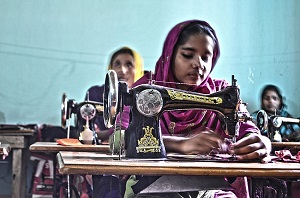
CODE OF CONDUCT AGREED BY THE CLINTON COALITION IN APRIL 1997
The Apparel Industry Partnership has addressed issues related to the eradication of sweatshops in the United States and aborad.FORCED LABOR. There shall not be any use of forced labor, whether in the form of prison labor, indentured labor, bonded labor or otherwise.
CHILD LABOR. No personal shall be employed at an age younger than 15 (or 14 where the law of country of manufacture allows) or younger than the age for completing compulsory education in the country of manufacture where such age is higher than 15.
HARASSMENT or ABUSE. Every employee shall be treated with respect and dignity. No employee shall be subject to any physical, sexual, psychological or verbal harassment or abuse.
NONDISCRIMINATION. No person shall be subject to any discrimination in employment, including hiring, salary, benefits, advancement, discipline, termination or retirement, on the basis of gender, race, religion, age, disability, sexual orientation, nationality, political opinion, or social or ethnic origin.
HEALTH & SAFETY. Employers shall provide a safe and healthy working environment to prevent accidents and injury to health arising out of, linked with, or occuring in the course of work or as a result of the operation of employer facilities.
FREEDOM of ASSOCIATION and COLLECTIVE BARGANING. Employers shall recognize and respect the rights of employees to freedom of association and collective barganing.
WAGES & BENEFITS. Employers recognize that wages are essential to meeting employers' basic needs. Employers shall pay employees, as a floor, at least the minimum wage required by local law or the prevailing industry wage, whichever is higher, and shall provide legally mandated benefits.
HOURS of WORK. Except in extraordinary business circumstances, employees shall (i) not require to work more than the lesser of (a) 48 hours per week and 12 hours of overtime or (b) the limit on regular and overtime hours allowed by the law of the country of manufacture or, where the alws of such country do not limit the hours of work, the regular work week in such country plus 12 hours overtime and (ii) be entitled to at least one day off in every seven day period.
OVERTIME COMPENSATION. In addition to their compensation for regular hours of work, employees shall be compensated for overtime hours at such premium rate as is legally required in the country of manufacture or, in those countries where such laws do not exist, at a rate at least equal to their regular hourly compensationr rate.
Any company that determines to adopt the Workplace Code of Conduct shall, in addition to complying with all applicable laws of the country of manufacture, comply with and support the Workplace Code of Conduct in accordance with the attached Principles of Monitoring and shall apply the higher standard in cases of differences of conflicts. Any company that determines to adopt the workplace Code of Conduct also shall require its contractors and, in the case of a retailer, its suppliers to comply with applicable local laws and with this Code in accordance with the attached Principles of Monitoring and to apply the higher standard in cases of differences or conflicts.
COMMENTARY: what the agreement really means
[Note: Commentary on the Task Force agreement includes text from a press release issued April 12 by Medea Benjamin of Global Exchange, Trim Bissell of Campaign for Labor Rights, Dr. Elaine Bernard of Harvard University Trade Union Program, Thuyen Nguyen of Vietnam Labor Watch, Jeff Ballinger of Press for Change, Max White of Justice Do It Nike and Reverand Max Surjadinata of United Church of Christ.]
On August 2nd 1996, in a Rose Garden press conference, President Clinton and then-Secretary of Labor Robert Reich announced the formation of a Task Force charged with producing standards for a "no sweat" clothing label within 6 months. The Task Force consisted of apparel industry giants like Nike and Liz Claiborne and several human rights and labor groups. That the Task Force took nearly 8 months to produce a report was due to intransigence by industry representatives, who refused to accept any meaningful change from the status quo.
The Presidential Task Force's agreement on sweatshops, to be released on April 14, demonstrates that grassroots activism is still needed to win justice for apparel industry workers - now more than ever. Unfortunately, the good-faith efforts of the human rights and labor representatives on the task force were not matched by the representatives of the apparel industry. (Are we surprised?) Industry reps stonewalled on every major point which might have ameliorated the misery of those whose labors enrich them. Among the horrors of this agreement are the following points:
- Companies shall pay the local minimum wage or prevailing industry wage.
It is widely ackowledged that third world countries tend to set the minimum wage well below what workers need to meet even their most basic needs. They do so to encourage investment by foreign capital. In effect, then, it is the garment industry and not truly the countries themselves which set legal minimum wages so low - because governments understand full well that the industry locates its production in the lowest wage havens. What we have, with the Task Force agreement, is an industry promise to "comply" with the low-wage standard that its own practices have created.
- The agreement accepts a 60-hour work week (48 hours plus 12 hours mandatory overtime) as the norm and then says, "Except in extraordinary business circumstances," workers will not be forced to work more than that.
Anything could qualify as an "extraordinary circumstance," making even the commitment to an outrageous 60-hour week meaningless. Moreover, the agreement addresses only mandatory overtime. Already, garment industry workers put in endless hours of supposedly "voluntary" overtime. There should be NO mandatory overtime. If workers were paid a living wage for an 8-hour day, excessive "voluntary" overtime would cease.
- Employees shall be compensated for overtime hours at the legal rate or, where none exists, at a rate at least equal to their regular hourly compensation rate.
Labor unions the world over call for overtime to be paid at a higher rate than the regular hourly wage. The Task Force agreement should call for at least time-and-a-half for overtime.
- To verify whether industry complies with even these paltry standards, the agreement states that companies shall use independent external monitors.
The agreement does not insist that companies use local human rights, labor or religious groups that have the trust of the workers and knowledge of local conditions. Instead, the companies can use private accounting firms and merely "consult regularly" with local institutions. The "independence" of such firms is demonstrated by Nike's contract with the accounting firm of Ernst and,Young, which issues secret reports to Nike. Its monitoring has failed to prevent ongoing, systematic abuse by factories contracting to do production for Nike. As experience already has proven, employees working in repressive situations are unlikely to speak openly to representives of firms which are answerable only to the apparel companies.
THE RESULT OF THIS AGREEMENT is that apparel companies can continue to pay their workers 20 cents an hour for "regular" 60-hour work weeks, push them to do unlimited hours of "voluntary" overtime beyond that, monitor conditions via accounting firms which have no connections to the workers AND be rewarded for this behavior with a "no sweatshop" seal of approval.
The agreement produced by the Task Force demonstrates all too clearly that we cannot leave the fate of the world's apparel workers in the hands of presidential commissions. It is imperative that grassroots activists continue to support struggling factory workers, mobilize public opinion and pressure abusive corporations until workers at home and abroad are paid living wages and treated with dignity.
MONITORING: According to the agreement, companies must put in place a system to monitor the factories that produce the products they sell. The question is what constitutes independent monitoring is probably the hottest area of contention in labor rights. For example, Nike says that the accounting firm of Ernst and Young serves as its independent monitor. Ernst and Young' reports to Nike are not available to public. In the most literal sense, then Ernst and Young is answerable only to Nike. So activists worry that the accord does not guarantee truly independent monitoring. One pole of opinion has it that the agreement "leaves the foxes even more firmly in control of the hen house, which now carries the label 'Fox Free". A more sanguine assessment, by a member of the task forse, says that the principles of monitoring will lead inevitably to participation by local human and labor rights organizations, which are supposed to be consulted by the monitors. In the middle ground, most are cautiously pessimistic. (for the consultation of the full text of the agreement see "Report of Apparel Industry Partnership")
REQUESTED ACTIONS:
1. CONTACT THE WHITE HOUSE. Let it be known that you want meaningful standards for a "no sweat" label. A good place to begin is with wages. As noted above, the apparel industry situates its production in countries where the minimum wage is widely acknowledged to be set below a livable rate sufficient to meet even the most basic needs of workers and their families. In most cases, the legal minimum wage is barely half of what workers truly require. If the members of the Presidential Task Force wish to demonstrate sincerity, they should swiftly and publicly commit themselves to paying at least double the legal minimun in the countries where they produce. Further, they should commit themselves to having that new standard fully implemented during the six-month transition period of the agreement. White House comment line: 202-456-1111, fax: 202-456-2461, email: president@whitehouse.gov
2. CONTINUE TO SUPPORT CAMPAIGNS for the rights of working people around the world and here at home. Important campaigns being conducted at this time include: Nike, Disney, Guess, Starbucks, Hyundai in Tijuana, California strawberry growers, the Case Farms poultry processing plant in North Carolina and the FLAV-R-PAC and Gardenburger boycotts in support of Oregon farmworkers.
Sources of information on these campaigns:
Campaign for Labor Rights newsletter.
Send $35 to 1247 "E" Street SE,
Washington, DC 20003. For a sample copy, contact clr@igc.apc.org or
(541)344-5410.
Watch our Labor Alerts/Labor News Service for more information.
Campaign for Labor Rights web site: http://www.compugraph.com/clr
Action packets: Contact Campaign for Labor Rights at clr@igc.apc.org or (541) 344-5410 and we will put you in touch with the organization which produces action packets for any of the campaigns which we support. In the case of the Nike campaign, Campaign for Labor Rights produces a constantly-revised action packet, available by email or in hard copy ($3 or $5 donation requested for hard copy version).