ARE SOCIAL CLAUSES THE ANSWER?
(WWW - November 1996)
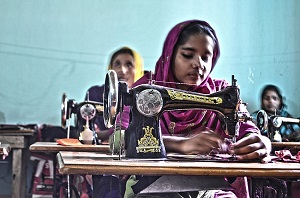
KEY ISSUES FOR WOMEN WORKERS
A social clause can only rebte to paid work. It is also highly unlikely that intetnational standards would be enforced beyond the formal sector; to do this would require massive resources for monitoring at a local level. It is even possible that the pressure to enforce standards could lead to an even greater difference between the formal sector and informal and unpaid work. This would tend to widen the gap between male and female workers even further.
On the other hand, international regulation could be of more value to women than men. It is women workers who tend to suffer the worst conditions and whose needs are systematically ignored. Their situation has often been beyond the reach of both national legislation and trade union organisation. Social clauses could provide a springboard for women to organise and demand that more serious attention be paid to their working conditions. However, this would only happen if resources were clearly allocated for women organising both within and outside trade union structures.
Social clause proposals define labour standards with reference to ILO conventions. All include-the abolition of forced labour, freedom of association and the right to collective bargaining. Many include the prevention of discriminabon in employrnent, equal pay and minimum age of employment.
These ILO conventions are widely ratified as representing fundamental rights of all workers. However, there are few countries where they are effectively put into practice and the number is decreasing with the expansion ot the free trade agenda. One key question then is whether trade santions would in practice be imposed objectively or whether they would be used selectively by the most powerful nations.
The convention on minimum age of employment is controversial amongst activists. All are against the exploitation of children. However, the value of any extetnally imposed sanctions is highly questionable without a genuine commitment to financing programmes for children's education and the employment of adult family members.
There is no doubt that women see freedom from discrimination and the right to equal pay as basic rights. Again the question concerns what would happen in practice. In the few countries where there have been attempts to implement these rights progress has only been made as a result of strong lobbying and the deployment of considerable resources. No proposal has been made for such resources to be provided at an international level.
Women workers have other demands
Two areas always come towards the top of women's agenda and yet are rarely mentioned in mainstream debates on workers rights:
1. Reproductive rights
Workers also have the right to produce and care for children.
The failure to recognise this right has prompted strong campaigns by women workers for maternity leave, child care facilities, the right to refuse to work overtime etc. Increasingly these are seen as rights for men as well as women.
2. The right to bodily integrity
Freedom from physical and sexual abuse is frequently identified by women as one of their most urgent rights as workers. Yet the shame attached to the issue means that it is rarely raised in formal discussion.
Workers rights are not enough
For women it is difficult to separate their rights as workers from their rights as equal citizens. For example what can be achieved by ending discrimination at work if women are denied the right to education; or by bringing about equal pay if women do not have the right to control their eamings?
Economic changes associated with trade liberalisation have reduced women's chances of achieving greater equality in a great many countries. Opportunities for education and training have been reduced and the burden of domestic labour increased. Unless resources are recommitted to reversing this situation equal rights at work will be meaningless.
There is also concern that the demands of workers themselves would not necessarily be reflected. In the current proposals any move to impose sanctions would be decided in high level negotiations and would involve protracted and legalistic procedures. It is difficult to see how the interests of women workers could be represented. This contrasts, for example, with the passing of the recent ILO Convention on Home working, which was the outcome of international negotiations influenced by organisations directly representing workers.
Questioning global economic policies
It is important to ask how social clause proposals fit into the international movement for the reform of global economic policies. IMF and World Bank policies have been widely criticised for driving down conditions for the poorest workers and for women in particular. What can be achieved by introducing a social clause in this context? Unless radically different approaches are adopted to the debt crisis, poor countries will be placed in a situation where they are required to meet labour standards they are systematically prevented from reaching. Social clauses only make sense if they are approached within the framework of an overall campaign to reverse the harmful effects of current economic policies. This involves specific measures to achieve greater economic justice for women.
Challenging multinational companies
Social clauses are about sanctioning countries which fail to ensure adequate labour standards. If effective, this would limit the freedom of multinational companies. However companies tnemselves are not targeted by social clauses. As long as trade sanctions are imposed on a country by country basis companies will be able to avoid improving standards by moving production sites. Social clauses would therefore need to be accompanied by the enforcement of independently monitored company codes of conduct. To reach the majority of women workers these need to be operative throughout sub-contracting chains.
Supporting local action
Perhaps the key question is how such international sanctions would be linked to the industrial action of women workers themselves. No internationally imposed regulations can work unless they are backed up by strong action at a local and national level. This means that the demands being made in such agreements need to be consistent with the demands being made by workers themselves.
International support is needed to ensure that workers have the ability and resources to organise around their demands. Particular support is needed for women workers, most of whom are not fully represented through trade union structures. Yet there is little indication that such resources would be made available. The danger is of a gap between the high level legalistic bureaucracy of social clause implementation and women's everyday struggle to gain more control over their working lives. As long as this gap remains so will the threat to labour standards.
QUESTIONS CONCERNING CURRENT PROPOSALS
1. Social clauses are aimed at supporting workers in the most disadvantaged situations, so:
What procedures have been established for consulting:
- workers in places where there is no freedom of association (e.g.China)
- non unionised workers, notably those in the informal sector
2. Women are often in the most disadvantaged positions and have their own particular demands, so:
What is the consultation process
- with women workers as a separate group
- with organisations which represent many 'hidden' women workers (such as home working alliances)
3. Social clauses will only be effective if linked to local action, so:
What level of resources have been commilted to
- strengthening the organising power of workers at local level
- increasing workers awareness of global issues
4. A social clause is a top down bureaucratic procedure, so:
What mechanisms would be established to ensure
- consistency with workers' own demands
- guarantees against job losses
- workers involvement in implementation and monitoring
5. International instruments are notoriously difficut to implement, so:
What procedures would be established for monitoring compliance in non-formal sectors where the majority of women are located?
6. Almost all countries, including the USA and UK, fail to implement the ILO Conventions embodied in social clause proposals, so:
What are the criteria by which support would be given to procedures against any particular country?
7. Little is known about the long term conseguences of social clauses, so:
What research has been carried out to assess the likely impact of social clauses on different groups of workers?
RECOMMENDATIONS
International regulation of labour standards is needed. However the inclusion of a social clause in international trade agreements should not be seen as a panacea for the protection of workers rights. The benefits of existing proposals are uncertain and much would depend on the manner of implementation.
A social clause could only improve conditions for women workers in the context of a wider intemational programme in support of both workers' and women's rights.
The priority should be the commitment of more international resources to initiatives which:
1. Challenge the free trade agenda.
A concerted campaign is needed to prevent neo-liberal economic policies increasing poverty and eroding workers rights. Without this, social clauses will fail to have any
significant impact on labour standards
This involves:
- alliances between worker and consumer organisations
- campaigns for company codes of conduct which are independently monitored and involve workers at shop floor level
3. Support workers mobilisation, especially:
- in countries where there is little or no freedom of association
- in situations where trade union organisation is difficult (emigrant workers)
- for women workers organising outside mainstream trade unions
4. Provide a basis tor gender equality at work, by:
- challenging the fundamental causes of economic inequality
- addressing unpaid as well as paid work
- initiating positive action such as education and training
5. Increase knowledge, through gender sensitive programmes of:
- participatory research on the impact of the free trade agenda
- research into the implications of social clauses for particular groups of workers
- education on globalisation for workers at grass root level.
6. Widen the consultation process on the social clause issue to include:
- workers organised at local level
- organisations representing women workers
- organisations represenhng workers in places where unions are banned
7. Widen the notion of workers rights to:
- link more closely with human rights in general
- include reproductive rights and the right to bodily integrity
8. Campaign for transparency and democracy in global institutions such as the WTO, through:
- the seffing up of consultative mechanisms for representative organisations
- the rebase of official documents
- the establishment of a gender balance on all relevant bodies
9. Strengthen and democratise procedures for implementation of standards:
- Increase resources to the ILO as a tripartite body with the ability to undertake independent surveillance
- Facilitate the involvement of organisations directly representing workers
- Provide resources for programmes to enable compliance
By Angela Hale