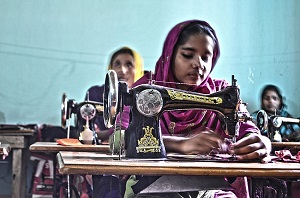
Source: Campaign for Labor Rights and New
York Times - November 5, 1998
by Steven Greenhouse
The Union of Needletrades Industrial and Textile Employees declared they would no longer participate in the presidential task force if other members moved forward with the new agreement, reached on November 3, 1998. Interfaith Center on Corporate Responsibility has also declared it can't endorse the agreement.
The pact grows out of a presidential task force, the White House Apparel Industry Partnership, that was set up in 1996 after embarrassing revelations that apparel produced under the Kathie Lee Gifford name was being made in sweatshops in New York and Central America.
After the task force's 18 members remained stalemated for months, nine of the group's more centrist members began negotiating among themselves and finished thrashing out an agreement on Monday. This group presented the agreement to the other members Monday night in the hope that they would accept it.
The nine task force members that reached the new agreement are Liz Claiborne, Nike, Reebok, Phillips Van Heusen, Business for Social Responsibility, the Lawyers Committee for Human Rights, the National Consumers League, the International Labor Rights Fund and the Robert F. Kennedy Memorial Center for Human Rights.
Four other corporate task force members, L.L. Bean, Patagonia, Nicole Miller and Kathie Lee Gifford, have accepted the new agreement.
"This agreement is only the beginning," President Clinton said. "We know that sweatshop labor will not vanish overnight. While this agreement is a historic step, we must measure our progress by how we change and improve the lives and livelihoods of apparel workers here in the United States and around the world. That is why I urge more companies to join this effort."
Several corporate members said that if the task force accepts the stricter requirements sought by union leaders, that would make it harder to persuade more companies to join the effort.
Under the agreement, factories used by American companies could not use forced labor and could not require employees to work more than 60 hours each week. In addition, the agreement prohibits factories from employing children younger than 15, although employment of 14-year-olds would be allowed when the country of manufacture allows employment at that age.
The agreement also requires employers to pay the minimum wage required by local law or the prevailing industry wage, whichever is higher. Labor unions have repeatedly complained that in countries like Indonesia and Vietnam, both the minimum wage and prevailing wage are too low to support a family.
Under the accord, a new entity, the Fair Labor Association, would be set up to oversee compliance. The new association would certify which monitors could examine factories, and it could expel companies that do not comply with the code. Many of the monitors would be accounting firms, but the accord urges all monitors to work with nongovernmental groups, like human rights groups, to get an accurate picture of conditions.
The agreement calls for companies to monitor all their factories themselves, but in addition requires outside monitors to examine 30 percent of a company's factories in the three years after a company agrees to comply with the code of conduct. In subsequent years, about 10 percent of a company's factories would be inspected annually.
"We cannot continue to participate in this effort on the basis of this agreement," said Alan Howard, assistant to the president of the needletrades union. "This has been offered to us on a take it or leave it basis and we can't take it."
"We are...concerned that this agreement will reinforce the tendency to view voluntary corporate codes of conduct as a substitute for the enforcement of existing laws and the adoption of legislation and trade agreements designed to protect the rights of workers in the global economy. While such
codes can in some circumstances supplement the rule of law in protecting workers rights, they are a step backward when they undercut the demands and actions of the anti-sweatshop movement and allow corporations to carry on business as usual."
"The monitoring is badly flawed," Howard said. "We don't think it's very independent monitoring and the companies pick their monitors and the factories to be monitored so there won't be surprise inspections."
The union's biggest criticism is the accord's failure to require that companies pay a living wage.
Human rights groups that backed the agreement said they persuaded the companies to agree to a Department of Labor study on the minimum and prevailing wages in relevant countries and how those wages compare with the amount needed to meet workers' basic needs.
"Those of us on the nongovernment organization
side are continuing to fight for higher wages in this industry,"
said Michael Posner, executive director of the Lawyers Committee
for Human Rights. "This issue is central to our thinking
going forward. Remember, this a first step and we have a lot of
work to do to make this work."
Commentary by UNITE
1. The Governance structure is ostensibly fairly balanced, with half companies, half labor/NGOs and a neutral chair. In practice, it gives any three companies the power of veto on key questions requiring
"supermajority" vote, such as amending the code and bylaws, selection of a chair and executive director, changes in caps on annual assessments for companies, adoption and modification of accreditation criteria for monitors, changes in the percentage of company facilities subject to inspection and declaring a company no longer in compliance with the code. Note that the decision
to certify a company is by a simple majority vote, which means a company can be certified despite all the non-company members voting against but cannot be decertified even if all the non-company members and half the company members vote to decertify. This is a formula biased toward approval of compliance and in those instances when three non-company members assert their veto an invitation to deadlock. Either option perpetuates the status quo in the industry.
2. The participation criteria for companies is minimal, essentially requiring a statement of the company's intention to adhere to the rules and the payment of an assessment inadequate to fund the organization at a level capable of enforcing the code. Participation also allows the company
and Association to announce publicly that the company is seeking certification for specific brands, as distinct form already have such certification. This distinction is not one that the typical consumer is likely to notice, thus creating a false impression for a long as three years that the company is in compliance.
3. Companies are free to choose the same accounting firms as monitors that they have always employed for that purpose, including firms that perform other services for the company. Restrictions on such conflicts of interest are fraught with loopholes and broad discretionary language, such as the Association's right to waive the application of certain provisions on "good faith" showing of "ethical walls" between employees of accounting firms that also engage in monitoring.
4. On the basis of as few as 10% of a company's facilities subject to an annual inspection in an initial three-year implementation period and as few as 5% a year thereafter (the percentages are even lower taking into consideration De Minimis facilities excluded from the total count) a company could be declared in compliance with the code.
5. In addition to selecting and paying the monitors, companies will also choose the facilities to be inspected. While the Executive Director of the Association has the authority to modify the inspection list proposed by the company, the procedure assures that the company will always have foreknowledge of which plants will be inspected and that "there shall be a general assumption in favor of the Participating Company's suggested list of Applicable Facilities."
6. Companies will be reimbursed by the Association for monitoring costs. To the extent that this project is supported by public funds, and we are told that the government commitments have been made, this means that firms like NIKE will receive a government subsidy to conduct company controlled inspections of its production facilities that will allow the company to declare it is in compliance with the code. This is a blatant and totally unacceptable step toward the privatization of enforcing labor standards.
7. The Association's annual public report on the company will be based exclusively on information provided by the company and its monitor's own reporting and assessment of findings regarding non-compliance and remedial actions and will not identify the specific factories that have been inspected. In the event of a company being placed on an indefinite "special review" status for non-compliance with various criteria, the public will not be notified of such a determination nor informed of the reasons for such a determination. In the case of ongoing inspection reports filed with the company by monitors, the Association will not be informed of their results for 60 days and the reports will contain specific information only on "significant and/or persistent patterns of non-compliance or instances of serous non-compliance."
8. The proposed Department of Labor Wage Study will establish official poverty levels as the "basic needs" standard now in the code. Furthermore, neither here nor anywhere else in the agreement odes the Association take responsibility to determine prevailing wages in the industry, thus rendering inoperative the provision in the code that obligates companies to pay prevailing wages when they are higher than legal minimums. Finally, by dropping language in the labor/NGO proposal requiring the Association to "establish a process that examines workers' basic needs, minimum and prevailing wages, and the extent to which the latter meet the former," this agreement takes a giant step backward on the right of workers to be paid a living wage.
9. The watered-down version of Special Country Guidelines is virtually a license for companies to produce in any country regardless of the legal and practical prohibitions on freedom of association, the right to organize and bargain collectively. Almost all of the specific provisions in the labor/NGO proposal have been throw out and replaced with generalities and high-sounding principles. The only specific restriction is that factory owners "not affirmatively seek the assistance of state authorities to prevent workers from exercising these rights." This presumably means you can let the army in the door but you can't call them. Compare this with the codes and restrictions placed on multinational corporations in apartheid South Africa and the hollowness of this provision becomes clear.
10. The Third Party Complaint Procedure is a laudable attempt to introduce a necessary degree of public accountability into this sealed system. However, the multiple qualifications for lodging such complaints, the lack of any public notification of such complaints and their determination, and the authority of the company and its monitor to verify and evaluate their accuracy is more likely to conceal wrongdoing than expose it.
11. As noted above, the absurdly low assessment caps on participating companies (a billion dollar company would apparently only have to pay $10,000, though this is necessarily extrapolated from a formula that is not explained) assures a chronically underfunded Association without the capability of carrying out its responsibilities.
UNITE (Union of Needletrades, Industrial and Textile Employees) Statement on the White House Apparel Industry Partnership Despite high hopes and a shared sense of urgency, UNITE cannot continue to participate in the Apparel Industry Partnership on the basis of the agreement recently reached by some company and NGO members of the Partnership.
No voluntary corporate code of conduct can assure the enforcement of workers rights and the elimination of sweatshops. For such a code to be helpful in reaching these objectives, it must have standards that permit workers to live and work with dignity and effective enforcement mechanisms for those standards.
This agreement fails to meet this threshold on several counts. It takes no meaningful step toward a living wage; it does not effectively address the problem of protecting the right to organize in countries where that right is systematically denied; it allows companies to pick the factories that will be inspected by monitors chosen and paid by the company and excludes up to 95% of a company's production facilities from inspection; and it creates multiple barriers to public access to information. These are fatal flaws in a code already diluted by previous compromises.
We are also concerned that this agreement will reinforce the tendency to view voluntary corporate codes of conduct as a substitute for the enforcement of existing laws and the adoption of legislation and trade agreements designed to protect the rights of workers in the global economy.
While such codes can in some circumstances supplement the rule of law in protecting workers rights, they are a step backward when they undercut the demands and actions of the anti-sweatshop movement and allow corporations to carry on business as usual.
UNITE remains committed to continue working
with employers, government and concerned organizations to develop
mechanisms that raise the standards of competition in the apparel
industry and assure consumers that the clothes they buy are not
produced by oppressed, exploited and abused workers anywhere.
Statement from the Interfaith Center on Corporate Responsibility
Religious Investor Coalition Declines to Endorse Apparel Industry Partnership Agreement Thursday, November 5, 1998 - Charging the agreement fails to guarantee payment of a sustainable living wage and establish effective independent monitoring by local non-governmental organizations, the Interfaith Center on Corporate Responsibility announced today it was not able to endorse an agreement reached by companies and human rights groups in the White House Apparel Industry Partnership. ICCR has been a member of the Partnership since its inception in 1996.
"Key principles, such as payment of a sustainable living wage to employees, and credible independent monitoring, are not sufficiently addressed," explained ICCR Executive Director Timothy Smith. "The agreement does take several important steps by establishing a Fair Labor Association and a process for monitoring factories worldwide, but without these key principles, we cannot sign on at this time." Mr. Smith added: "ICCR will continue our decades-old campaign to eliminate sweatshop as we will also work with the Partnership toward the mutual goal of eliminating sweatshops worldwide.
ICCR is an association of 275 Protestant, Roman Catholic and Jewish denominations, religious communities, pension funds, hospital corporations, foundations with over $90 billion in combined portfolio worth. ICCR members have been calling for just wages since 1975 when they challenged Gulf + Western to raise wages and improve working conditions on its sugar plantations in the Dominican Republic.
"The agreement provides for a study of wages," said Rev. David M. Schilling, who represented ICCR on the Partnership. "But it does not commit participating companies to pay a sustainable living wage in apparel and footwear plants around the world. A factory may be clean, well organized and monitored, but unless the workers are paid a sustainable living wage, it is still a sweatshop."
A key criticism of religious groups is that the Agreement does not provide for a process to determine what is a living wage. While the Agreement calls for a Department of Labor wage study to compile existing wage data, the Fair Labor Association is not empowered to do the purchasing power studies necessary to determine whether or not wages are sufficient to meet a worker's basic needs and provide some discretionary income, according to Rev. Schilling.
"Independent monitoring of factories using local human rights, religious and other non-governmental organizations (NGOs) is also crucial to establishing a credible anti-sweatshop program," explained Dr. Ruth Rosenbaum, co-chair of ICCR's Global Corporate Accountability Issue Group. "As it is, this Agreement would set up a monitoring norm where only 10% of a company's supplier factories would be independently monitored each year. In addition, we are concerned that large auditing firms will become the Association's 'independent monitors,' marginalizing participation by NGOs who know the local context and are more likely to have the trust of workers." Dr. Rosenbaum is the director of the Center for Reflection Education and Action of Hartford, Connecticut.
Sister Dolores Brooks, OP, Co-Chair of ICCR's Global Corporate Accountability Issue Group, added: "We are pleased that the Workplace Code includes respect for the right of workers to freely associate and bargain collectively. However, the Agreement does not spell out what companies need to do in countries where this internationally-recognized right is denied. Independent unions, controlled by workers, are an important element in the struggle to eliminate sweatshops." Sr. Brooks is a member of the investment committee of the Sinsinawa Dominicans.
According to ICCR representatives, positive elements of the Agreement include: acceptance of both internal and independent external monitoring, a third party complaint procedure and a pledge by the companies in the agreement to work in partnership with others to address questions critical to the elimination of sweatshop practices.
"As we carefully follow the implementation
of the Agreement," stated Mr. Smith, "we plan to keep
the door open to endorsement of a future strengthened Agreement."
Joint statement by Lenore Miller (Retail, Wholesale and Department Store Union), Jay Mazur (UNITE) and John J. Sweeney (AFL-CIO).
The initiative of President Clinton in establishing the White House Apparel Industry Partnership could not have been more important or timely. President Clinton's commitment to bring together major apparel companies, labor unions, human rights and consumer groups to find solutions to the industry's sweatshop problems was exactly right. All the parties concerned with the industry's problems need to work together to raise the standards of competition in one of the most globalized of all industries.
Participants in the partnership deliberated for two years, sharing their different perspectives, exploring solutions together and negotiating sometimes very difficult issues to find solutions to common problems without fundamentally compromising legitimate differences of interest. The American labor movement participated actively in this process form the beginning and was represented there by Jay Mazur of the Union of Needletrades, Industrial and Textile Workers and Lenore Miller of the Retail, Whole and Department Store Union.
Despite the seriousness of these deliberations - and the good faith in which we believe the negotiations were conducted - the labor movement has concluded that signing on to an agreement with the participating companies is not possible at this time and is, therefore, not participating in the tentative agreement that was signed by the companies and some of the participating NGOs earlier this week.
American unions are committed more than ever
to the essential work of eliminating sweated labor from the American
workplace and from the products which American consumers buy.
We will continue to raise the standards of competition in the
apparel industry and assure American consumers that the apparel
they buy is not produced by oppressed, exploited and abused workers
anywhere.
Memorandum to all Members of the Apparel Industry Partnership from Business for Social Responsibility, International Labor Rights Fund, Lawyers Committee for Human Rights, Liz Claiborne, National Consumers League, Nike, Phillips Van Heusen, Reebok, Robert F. Kennedy Memorial Center for Human Rights:
As all of you know, our group has been meeting informally since the summer in an effort to address unresolved issues in our negotiating process and to help forge an agreement. Several weeks ago we met in New York and reached a preliminary agreement on a draft Charter, a copy of which is enclosed.
All of us view this agreement as an important step forward in the effort to address violations of labor rights in the apparel and footwear industries worldwide. It will enable us to create a new entity, the Fair Labor Association, through which we can address worker rights issues going forward. It will also allow us to educate consumers about our efforts, thereby making it easier for them to make informed purchasing decisions.
This agreement is the product of an arduous negotiating process. Each of our organizations has made compromises to reach this agreement. But we all feel that, viewed in its totality, the agreement creates a solid foundation for providing essential safeguards to workers. We believe that we have reached a stronger, more credible agreement precisely because over the last two years the real parties at interest have been so closely involved in the negotiating process.
Each of the nine organizations that have been participating in this informal process is committed to moving forward on the basis of this agreement, and using it to encourage the participation of a broad segment of members of the apparel and footwear industries, unions and ngos. We hope that the eight remaining members of the AIP will join us in supporting the agreement, which contains these key provisions:
1. The creation of a new non-profit organization, the Fair Labor Association, governed by an equal number of company representatives and representatives of labor, consumer, human rights, labor rights, religious and other public interest organizations that work on issues related to fair labor standards.
2. A monitoring process that requires companies to develop and undertake comprehensive internal monitoring and to submit a significant number of their facilities to independent external monitoring.
3. A fair and rigorous process for the Fair Labor Association to accredit independent external monitors.
4. A reporting system that will provide the Fair Labor Association with the information it needs to determine whether participating companies are in compliance with the Workplace Code of Conduct and monitoring principles.
5. Regular reports to the public that will provide consumers with credible information on the performance of individual companies with respect to the Workplace Code of Conduct, information that can help consumers make better informed choices.
6. New provisions on the issues of wages and freedom of association that build on the language contained in the Workplace Code of Conduct. These new provisions take account of our differences on these issues and offer practical steps that will enable the Fair Labor Association to address them constructively.
Finally, we want to thank each of you for
your invaluable participation in this historic effort. As we move
forward to implement this agreement, we hope that you will join
with us to make the Fair Labor Association an effective entity
that will contribute to the protection of workers rights.