(China Labour Bulletin - March 1996)
Expressway for Foreign CapitalIn Western capitalist societies, governments and management are subject to monitoring and pressure from strong labour unions. After years of struggle by the labour movement, the mechanism of tripartite consultation is in place. Governments are not in a position to collude with management in whatever way they wish, and workers are cushioned against blatant exploitation by the management.
When foreign capital finds its way into China, it finds itself on a profit expressway. Workers in China cannot organise their own unions, which can engage in collective bargaining; they are pitted in a highly unfavourable position against foreign investors.
Although China is a signatory to various International Labour Organisation Conventions (ILC), it still refuses to ratify ILC Nos. 87 and 98. On the other hand, the Chinese government holds firmly to the policy of monopolising union organising with the government-controlled All China Federation of Trade Unions (ACFTU) as the only officially recognised union. All along, the government has used administrative and legal means to suppress the independent labour movement, and crack down on workers' struggles for la bour rights.
Labour Rights Brutally Suppressed
In 1989, the first ever workers' au tonomous federation (WAF) movement was brutally crushed. Members of WAFs all over the country received sentences of varying severity. Many of them are still behind bars; those who have been released are not able to find any work.
In May 1992, 16 members of an underground union, the Free Labour Union of China, were arrested, and in December 1994 were handed down heavy sentences of 5-20 years in prison.
In March 1994, the government got its hands on the League for the Protection of the Rights of Working People in China. Most of the league's members are still in jail.
In the same month, Zhou Guoqiang, a free labour movement activist in Beijing, was sentenced to three years' 're-educa tion through labour' without any judicial procedures. The 'crime' Zhou committed was 'inciting social discontent' by printing T-shirts advocating labour rights.
Three workers in Shenzhen were arrested for attempting to run evening schools for workers and to organise an independent union. Their whereabouts are still unknown.
Unchecked Exploitation
With the Chinese government's absolute control over public opinion, all these cases can represent only small pieces of the whole picture. Even so, it can still be seen that the government is sacrificing labour rights for its so-called economic reforms. Under these policies, then, what has foreign investment brought to China?
By the end of 1994, there were a total of 260,000 officially-registered for eign-invested enterprises (FIEs) in China, employing 1.95 million workers, with total investment amounting to US$490.7 billion. As they are afforded preferential treatment by the government, FIEs in China are immune to any monitoring. Some government officials and departments turn a blind eye to law-defying FIEs for fear of losing investment. The FlEs see through this psychology and use it as a threat against law-enforcement depart ments.
Workers are oppressed by FIEs as well, since they cannot organise their own unions and do not enjoy the right to col lective bargaining. Violation of labour rights in FIEs is rampant. Labour disputes in FIEs comprised at least 40% of all cases in 1994. These are the usual tricks used in FIEs:
1. Workers are required to pay a deposit upon recruitment, which usually adds up to two to three months' salary. They cannot claim back the deposit if they quit or get fired.
2. Workers ' identity cards and temporary residence permits are confiscated. Workers are virtually held in custody, since they cannot go anywhere without their identity cards.
3. Workers are paid less than the minimum wage. According to our survey of 14 foreign-invested electronic enterprises in Shenzhen, Zhuhai and Dongguan in Guangdong Province, eight of the enterprises (51.4%) offered wages far below the minimum level. On average, the wages were 17.86% less than the statutory minimum. The lowest wage level was found in Guanya Electronics Factory in Dongguan City, which paid 32.2% less than the minimum wage. The 'best' record was in Zhuhai, where wages were 9.4% less than the statutory minimum.
4. Wage arrears and underpa ment. Workers are usually paid one month in hand so that they are discouraged from quitting. Some receive their wages once every couple of months and some enterprises only pay the basic living allowances. Invariably, when the enterprises wind up, the workers cannot claim back their un paid wages. In an off1cial investigaion conducted in September 1994 in Guangdong Province, the main receptacle for foreign investment in China,25,000 workers were found to be underpaid or unpaid to the tune of Rmbl 6.52 million.
5. Working overtime with little or no overtime payment. Workers have to get management approval if they want to go out during weekends and holidays. In practice, only a few of them can go out, as there is a limited quota. In general, workers do not apply, since FlEs seldom offer holidays. In a survey on 13 FIEs in Guangdong Province, including American, Japanese, Hong Kong and Taiwanese factories, the longest overtime work recorded in 1995 was 222 hours a month. Workers had to work 15 hours a day. This contravenes the Labour Law, which states that "workers shall not work more than 8 hours a day and 44 hours a week. Overtime work shall not exceed 3 hours a day, subject to consultation with the union and workers, but shall not exceed 36 hours a month." In one FIE studied in the survey, Xianda Garment Co. Ltd., workers had to work an average of 160 hours' overtime a month. However, their wages fell far, far below the local statutory minimum standard Ñ compared with the statutory minimum of Rmb 300 a month, they got only Rmb 280, INCLUDING OVER TIME PAY! According to the Labour Law, wages for overtime work on week days and rest days should be 150-200% of the basic wages. Taking the average, wages for 160 hours' overtime work would work out at Rmb 490. Added to the basic wages, the workers should have been paid Rmb 790 a month. This meant that workers in this factory only got 35% of what they actually deserved!
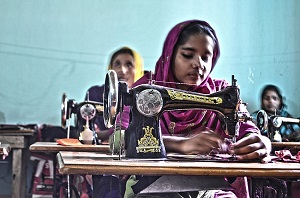
6. In enterprises where toxic chemicals are used, no explanations or training concerning the hazards and safety measures are given to the workers. Many workers suffer from poisoning, the environment suffers as well, with serious air and water pollution. This is particularly critical in the shoe industry. There are 150 shoe factories in Putian City in the coastal province of Fujian, nicknamed 'the shoe city'. Seventy thousand young women workers are employed in this shoe city, which has an annual production of 100 million pair of shoes, and an annual emission of 2,500 tonnes of toluene. The concentration of toluene in the factories is, on average, five times the safety standard. The level in some factories even ex ceeds 10 times the national safety standard. Only one shoe factory in the city has installed standard air-purifying equipment. Some factories use ventilation fans instead, but many others do not even bother to install ventilation fans.
The majority of factory owners refuse to arrange regular medical examinations for women workers as legally required. Obviously, the women workers dare not go for examinations on their own, as they risk dismissal if they are diagnosed with health problems. But when they do finally go for diagnosis, their health has often deteriorated to a critical state. From 1993 to the present, more than 10 women workers have been diagnosed with blood cancer, and 20 others with a kind of anaemia that affects fertility. Two women workers among them have died, both of whom were 7-8 months pregnant.
One large-scale FIE refuses to adopt any environmental and labour protection measures. There are four production lines, but no ventilation fans. Workers have to work in the toluene-saturated factory, which smells of acid. The factory owner said, "All shoe factories abroad are like this."
7. Inadequate or no safety measures. In order to earn as much as possible as soon as possible, factory owners will start up operations before fire prevention facilities are fully installed. To cut costs, some FIEs simply do not invest in fire-prevention measures and facilities at all; some others operate three-in-one factories (dormitory, warehouse and work shop in the same building). To prevent workers from leaving the factory 'unnecessarily', many factories keep their main exits and even emergency exits locked, and the windows sealed with steel bars. Repeatedly, the sealed factories have turned into infernos that have claimed heavy casualties and killed hundreds in serious industrial fires.
8. Harsh management. Most workers in the special economic zones come from poverty-stricken villages. They are nothing in the eyes of foreign investors. Physical and verbal abuse and arbitrary dismissals are the rule of the day.
In March 1995, workers in a Korean electronics factory in Zhuhai City were forced to work non-stop for four days with only five hours' sleep. The exhausted workers took a nap during the 10-minute afternoon rest period. Angered by their 'laziness', the factory boss or dered the whole staff to kneel down. Some refused and were sacked immedi ately.
In 1993, the Gaofu Textile Co. Ltd. in Fujian Province was set on fire by sacked women workers whom the management had accused of stealing from the factory. They had no way to seek justice. Driven by their grievances and anger, one of them set the factory on fire, claiming 61 lives. She later received a death sentence.
A worker in a Taiwanese shoe factory was locked into a dog's cage with a pair of shoes hung around her neck. The 'reason' Ñ she had allegedly stolen from the factory.
Over the past ten years or so, foreign capital in China has been on a fast track, with no red lights. Government policies function more as a shield against the development of a labour movement that could counter blatant exploitation by the capitalists. The unequal power distribution between labour and capital, which is the result of deliberate effort, has brought the special economic zones to the barbaric exploitative state seen in early capitalist societies. As China is being fast integrated into the world trade system, workers in China are no longer slaves of the state; they are slaves of the state and international capital.
FOREIGN-INVESTED INFERNOS
May 1991
November 1993
Hong Kong-owned Zhili Toy Factory (producing Chicco Toys) in Shenzen SEZ - 87 killed, 51 injured.
December 1993
Taiwanese Gaofu Textile Co. Ltd. in Fuzhou City, Fujian Province - 61 killed, all women.
June 1994
Hong Kong-owned Yuexin Textile Factory in Zhuhai SEZ - 93 killed, 160 injured; workers were asked to go back to the burnt factory building to take out the fabric. The building collapsed.
September 1995
Electric wire factory in Dongguan City - 7 killed, 4 injured.
New Year's Day 1996
Workers' dormitory of a Taiwanese Christmas decoration factory in Shenzen SEZ - 22 killed, 33 injured. The warehouse-turned-dormitory was built with corrugated iron. It housed more than 800 workers and masses of plastic materials. The only exits were the two main doors.
All these 'accidents' follow the same pattern: no fire prevention facilities, and blocked or saled emergency exits. In the first eleven months of 1995, 1, 184 fires were recorded in Guangdong Province, claiming 193 lives and injuring 268. Invariably, most of the casualties involved young women workers, who constitute the main workforce in foreign-invested enterprises.
SPECIAL ECONOMIC ZONES ARE FINE ZONES
One popular method of underpayment is the system of imposing fines on unreasonable pretexts:
SIDETRAKING: FINE!
In some factories, yellow lines are marked on the floor; this is the shortest path that workers have to follow when they go around different sections. If they step outside the yellow lines, they will be fined.
OVERTIME: FINE!
Most factories fix a time limit for going to the toilet, usually 3-5 minutes. If they stay longer than the limit, they will be fined.
GOING TO THE TOILET WITHOUT PERMIT: FINE!
In some factories, workers have to get a permit (a tag) from the supervisor if they want to go to the toilet. Going to the toilet without the tag: FINE! (NB: there are usually three to four tags for several dozen workers, mostly women).
There are many other creative excuses used, such as 'not willing to work overtime' and 'not greeting the general manager'. The high wages promised in these 'fine' FIEs are reduced one-third, or even less, by the end of the month. In some extreme cases, workers end up in debt to the factory.
In the Matsushita (National/Panasonic) Co. Ltd. in Zhuhai City, a warnning system of yellow cards is employed. Workers issued with a yellow card for the first time are fined Rmb 20, the second time, Rmb 40, the third time, Rmb 80 and the fourth time they receive a yellow card they are fired. Violation of regulations includes such acts as talking at work, not putting their name tags in the correct position, etc.