(J.Ballinger and C.Olsson, Behind the Swoosh, Global Publ. Foundation, 1997)
Nike sports shoes and clothing are easily identified by the company's distinctive logo, the "swoosh" tick, and its slogan "Just Do It".
Named after the Greek goddess of victory, Nike has its origins in 1964 when Oregon-based athlete turned businessman, Phillip Knight, hit on the idea of importing running shoes from Japan to compete with the German brands such as Adidas and Puma which were then dominating the US market. The advantage was that the Japanese shoes were cheaper because labour was cheaper in Japan.
He started out selling the shoes from the back of his car at athletic meetings, but sales soon took off dramatically. In the 1970s, Knight and his growing company spotted early the jogging revolution and began marketing to non-professional runners as well. Soon wider markets opened as running shoes became a fashion statement and everyone from kids to grannies began wearing them.
By 1979 Nike had half the market in the US and a tumover of US$149 million. In the mid 1980s however the company's seemingly unassailable position was hit when it failed to recognise the emerging market for women's aerobic shoes, and was overtaken as market leader by Reebok. But by 1990 it had regained its lead, largely due to the introduction of the "Air Jordan" shoe endorsed and promoted by basketball star Michael Jordan.
Today, Nike retains its position as market leader in sports shoes, and is a significant player in sports wear and accessories. Fortune magazine reported sales of US$3,7 billion in 1994 and profits of US$299 million (Fortune 1995). Some 60 percent of its sales are in the US, about 30 percent in Europe and 5 percent in Asia. (Nike 1993: 25).
The company and its founder have always had a reputation for being aggressive and unconventional, the "bad boys" of the shoe industry, built on an irreverence for the sporting establishment and for any authority which might cramp the individual's style.
The company's ethos involves a strong dedication to sport and fitness. Staff at the company's headquarters, the Nike World Campus at Beaverton, Oregon, are expected to spend a few hours each day in the gym. They are described by a former Nike director as "athletic, outdoor, lets-do-it-together types". (Boldersoll 1994: 82)
The company wants to be seen, in its OWII
words, as "young, American and hi-tech, devoting a lot of
attention to research and development". (Smit 1994: 23).
Manufacture in Asia
Apart from a brief but unsuccessful experiment with manufacturing in the US, Nike shoes have always been made in Asia, initially in Japan, then in South Korea and Taiwan, and more recently in China and Southeast Asia.
Nike began production in South Korea and Taiwan in 1972, attracted by the cheap labour there, and was soon joined by other companies including Adidas and Reebok.
But Nike went one step further. Instead of owning its own plants, it contracted production out to local Korean and Taiwanese.
companies. As Nike boss Phil Knight has said: "There is no value in making things any more. The value is added by careful research, by innovation and by marketing" (Katz 1994). Nike is now basically a designer and marketer of shoes. Manufacture is done by its Korean and Taiwanese suppliers. Once again, other companies have followed this model.
In the 1980s Nike tried to set up production in China, in partnership with state-owned enterprises, but this proved disastrous. But as China's door was opened to Taiwanese investors, Nike handed over production to these companies who simply moved across the Taiwan Strait into mainland China to take advantage of the cheaper labour there.
By the late 1980s changes in South Korea - labour unrest, increases in wage levels and loss of control of work places by Korean authorities - had made that country less attractive for investors, both foreign and domestic, who began looking for more congenial locations. With help from Nike in the form of guaranteed orders, the Korean companies, with whom it had by now developed a long-term relationship, moved their operations south to Thailand and Indonesia, in search of cheaper and less troublesome labour. Wages in those two countries were at that stage only a quarter of those in South Korea. Some of Nike's Taiwanese associates also set up in Southeast Asia.
Another reason for these moves was that in 1988, both South Korea and Taiwan lost their preferential access to US markets, which they had enjoyed as supposedly "developing countries" under the General System of Preferences (GSP). Korean and Taiwanese investors got around this by simply moving manufacture to Thailand, Indonesia and China and making use of the GSP privileges of those poorer countries.
Of Nike's seven top suppliers of sports shoes in 1992, three were Taiwanese companies producing mainly in China, three were South Korean, operating mainly in Indonesia, and one was a Thai company. (FEER 1992: 60).
Nike itself only employs some 12,000 people, most of them in the US. Its shoes and other products are produced by a workforce of perhaps several hundred thousand, employed by Asian suppliers.
As labour and other costs rise in Indonesia
and Thailand, it is likely that Nike and its business partners
will move again. They have already begun manufacturing in Vietnam
(Bours 1996) and there are reports of the company also investigating
possibilities in North Korea, Cambodia and India (Brookes and
Madden 1995: 6).
Nike in Indonesia
Nike has been operating in Indonesia since 1988 and nearly a third of its shoes are now sourced there. In a press interview in November 1994, the company's country coordinator in Jakarta, Tony Nava, said the firm used 11 main contractors in Indonesia and dozens of sub-contractors (Goozner 1994: 6). Among the former are Nike's long standing South Korean and Taiwanese associates - who also at the same time produce for other brands such as Reebok, Adidas and Puma.
The relationship between Nike and its contractors is quite close. There are Nike personnel in each of the plants of the contracted suppliers, checking that quality and workmanship meets Nike's stringent requirements. The November 1994 press article mentioned above also says that "Nike's regional headquarters designated two staffers to visit the main plants to look for labour law violations and unsafe conditions".
Most of the factories producing for Nike
are located in the newly developed light industrial areas in Tangerang
and Serang, to the west of Jakarta. In the Korean owned plants
(and in several of the Indonesian owned ones as well) the top
management is Korean. Middle level managers and supervisors may
be either Korean or Indonesian. But the production workers are
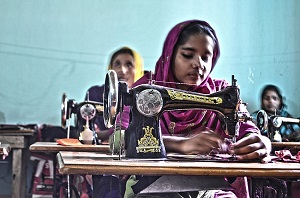
all Indonesian, predominantly young women in the 16 to 22 age
group, usually from other parts of Java.
A Globalised Industry
The production of Nike shoes is a truly global operation. Products are designed in the US, labour is carried out in cheap labour countries in Asia, using raw materials from several countries, and Korean, Taiwanese and Japanese capital; and the marketing is done all around the world. This method of organising is by no means unique to Nike. It is common throughout the shoe industry and in many other industries as well, including clothing, toys and electronics.
Gone are the days when companies operated largely within one home country and exported from there to other places. Production is now globalised, with different countries concentrating on different parts of the process depending on what they are good at, or can do most efficiently or cheaply. The more lucrative activities such as design and marketing are retained by the more affluent countries, who have the capital and are in a position to retain the best for themselves. Poorer countries get the less lucrative activities such as lowly paid semi-skilled or unskilled production or assembly.
Globalisation has given rise to an international division of ]abour in which countries undertake those economic activities in which they have a "comparative advantage". For many of the countries of South and Southeast Asia, their "comparative advantage" is their cheap labour - a result of massive chronic poverty, particularly in rural areas, which creates an oversupply of unskilled people seeking waged employment who are willing to work for almost anything.
Investors are able to move from country to country, if they so desire, to seek cheaper labour, as Nike's Korean and Taiwanese contractors did when they moved to south China and Southeast Asia in the late 1980s. This gives them vastly increased bargaining power vis-a-vis labour. The threat to close a plant and move elsewhere, with consequent loss of jobs, can be enough to undermine most claims for better wages and conditions. And it gives investors great bargaining power vis-a-vis governments who, in the belief that attracting foreign investment and new jobs is the answer to their economic problems, are competing with one another to offer the most favourable conditions for investors.
For a merchandising company like Nike, globalised production and sub-contracting has several advantages. First it enables these companies, who have names and public images to protect, to distance themselves from any exploitative labour conditions involved in the manufacture of their products. They can claim that it is not they who employ cheap labour, but their contracted suppliers, and hence the responsibility lies with the latter and not with them.
Second it enables them to play off one supplier against another, so as to obtain the cheapest price, while insisting on a high quality of work. In doing so, of course, they create the competitive pressure which leads to suppliers cutting costs by underpaying and overworking their employees, and skimping on facilities and safety.
And third it enables them to play off one
government against another so as to obtain the most favourable
investment conditions.
Nike in Australia
In Australia, Nike shoes and sports clothing manufactured in Indonesia, Thailand or China, are just as popular as they are elsewhere and the company is one of the leaders in the local market. Michael Jordan has just as much drawing power here as he has in other places.
In ] 993 Nike Australia Pty Ltd began signing up local sporting heroes - including Steve Moneghetti, Shane Warne and Cathy Freeman. The aim is to change the image of Nike from an American brand to that of "a global brand that has a lot of empathy with Australian sport" according to Ben Buckley, former Australian Rules football player and marketing manager for Nike in Australia. (Martini 1995: 18, 23).
The company became the object of some controversy
in March 1995 when it was named in Federal Parliament by Victorian
MP Peter Cleeland as one of 40 clothing labels whose products
he claimed were being made by exploited outworkers in Australia
- that is women, usually migrants, sewing garments at home who
are paid a small amount per piece rather than per hour worked.
The Situation in China
"By far the largest of the Taiwanese
enterprises in Dongguan is a gargantuan factory, Yu Yuan, that
employs some 40,000 workers, 70% of them temale, at a single enclosed
site. Reportedly the largest footwear factory in the world, it
produces ten of the world's top brand-name sports shoes and reportedly
a third of the world's Nike footwear. The Nike logo 'Just Do It'
covers the wall of one of the enterprise's cavernous buildings.
A huge 'Adidas' sign sits atop an adjoining building. Other sports
shoe brands that are produced in the same plant include Reebok,
Puma, LA Gear, and New Balance.
"Yu Yuan is run in a decidedly
military style. New recruits are given three days of "training".
The first day, according to one of them, is largely spent marching
around the compound, barked at by a drill sergeant. At 6:30 pm,
commands could clearly be heard in the background: "Left!
Right! Left! Right! About turn! March!..." Three formations,
each of about forty workers. were stil1 being drilled, while thousands
of other workers scurried back and forth between factory buildings
and mess halls to take their meals in shifts."
"Some work 12-hour shifts called
"long day shifts"; others are on "long night shifts".
Often these exceed 12 hours. As one of the workers explained,
"You work longer if you can't finish the day's allocated
quota. Another unpaid extra hour or so is spent in preparation
before the shift begins In addition, because there are long queues,
you need to arrive early at the gate so as to punch your card
on time, do the drills, and then line up to get to your shopfloor.
You can't afford to be late because there's a penalty equal to
half a day's wages".
"A large number of other workers
are on eight-hour shifts, but they are required to do considerahle
overtime work. I was there during a slack period and a worker
noted that he was working only one or two hours overtime a day,
seven days a week, and got one day off work every second week.
But during a busy period, he said, he had to work his day shift
from early morning till 11 PM or midnight. The slow workers stay
even later".
"Workers get a bit over 2 yuan
an hour (about 33 Australian cents), which is just above the minimum
legal wage. With about 80 hours of overtime work a month, their
monthly wages hover around 600-700 yuan ($100-110 a month)".
"The amount of enforced overtime
is in violation of China's labour laws, which stipulate a maximum
of 36 hours of overtime work each month. Yet, all things considered,
conditions at this city-sized factory are above average for the
district. The meals are subsidised, and there is medical care
and relatively 'low' density housing of 10 to a room. Signs screaming
out slogans like "Love your factory as your home" and
"Be loyal, be obedient, feel honoured to work here"
are mounted everywhere."
"Notwithstanding the signs,
the factory's turn-over rate is a high 7% a month, according to
one manager I spoke with.... New recruits who quit during the
six month probation period will. . . cause a month's loss of pay
to the fellow worker who introduced them to the factory and served
as their guarantor, often a relative or friend from their hometown."
From "Boot Camp At The Shoe Factory,
Where Taiwanese Bosses Drill Chinese Workers to Make Sneakers
for American Jogger", Washington Post, Outlook, November
3, 1996 by Anita Chan, a researcher at the Australian National
University. (Chan 1996)