Putting the boot into coasts
by Philip Parrish(Data Center Search Service, 1-2/1997)
Most people in Germany have heard of Herzogenaurach. The small town, a few kilometres north-east of Nuremberg, is notorious for playing host to the most famous fraternal spat in corporate history. The Dassler brothers, Rudolf and Adi, fell out after founding a shoe-making company in the town in I924. (To this day, only the Dassler family knows what the cause of the split was.) By I948 the rift was so great that the two set up rival companies within a stone's throw of each other. Rudolf formed Puma while Adi lent his name to Adidas. Herzogenaurach became the hub of the European sportswear industry as the two companies churned out product after product. Now, the loudest noise to be heard in the town is the crash of an accountant's computer. Apart from its headquarters and an r&d site up the road in even sleepier Scheinfeld, Adidas (the larger of the two) does very little in Germany any more. About 90% of its shoes and apparel products are made in Asia, north Africa and southern Europe.In I993, when chairman Robert Louis-Dreyfus was appointed, the transition away from production in western Europe was well advanced - costly plants in Austria and Germany had been closed by the start of the decade. But as an ex-chief executive of advertising firm Saatchi & Saatchi, Louis-Dreyfus wanted to accelerate the change. He not only wanted to cut costs but was also determined to move Adidas out of production. Louis-Dreyfus thought the company should concentrate instead on marketing and branding, the things it did best in his opinion. Production could be bought from suppliers. He took some controversial steps to implement this. For instance, his predecessor, Gilberte Beaux, had pledged in 1993 to keep open an Adidas factory at La Walck in France. Two years later, Louis-Dreyfus shut it down. The plant still makes Adidas goods but on a contract basis.
This is an exception though. Most of the contracted-out manufacturing has gone to locations outside pricey western Europe. However, unlike compatriot clothes maker Hugo Boss which shifted 80% of its production from Germany to eastern Europe, Adidas has generally steered clear of buying manufacturing supply in the former Communist Bloc. As recently as I992, just before the so-year-old Louis-Dreyfus took over, eastern Europe made some I6% of the company's apparel. Now, according to public relations manager Peter Csanadi, Adidas no longer sources manufacturing at all in the Czech Republic, former Yugoslavia, Hungary, Poland and Russia. Instead, Adidas prefers to buy its production from Asia, north Africa or southern Europe. Csanadi explains that Adidas found it difficult to operate in eastern Europe. In places like Korea, the contract manufacturing is handled out of a regional office in Hong Kong which has a high degree of autonomy. There is little or no involvement needed from head office in Germany. In eastern Europe, the production process required much more attention from Herzogenaurach. If there was a problem with delivery of shoelaces, for example, the problem often could not be solved locally, says Csanadi. The German hq would have to get involved to deliver hard currency to the factory to allow imports to be made. Csanadi says prices in eastern Europe have also gone up over the last five years. This has hit competitiveness and sent Adidas towards locations in Asia and north Africa and southern Europe.
Southern Europe locations enable fast, flexible response Places like Greece and Turkey are useful because they are close to western Europe - 67% of Adidas' market. This enables the company to respond to fluctuations in demand. For instance, in July this year, Englishman Alan Shearer became the world's most expensive soccer player when he signed for Newcastle United in the UK. Fans besieged the club store demanding Adidas shirts bearing Shearer's number nine. By the end of the day, a reported 7,000-plus shirts had been sold with many thousands more passing through the check-outs over the following weeks. To meet this kind of demand, says Csanadi, European countries such as Greece, Turkey and Portugal, supplemented by north African locations such as Tunisia, are favoured for logistical reasons. The faster delivery and stock turnover that these sites are able to provide for European customers outweighs their higher labour costs (compared with Asia). The company has to have some manufacturing in Europe for reasons of free trade as well. Production in Greece and Portugal, for instance, forestalls potential problems with EU textile quotas (such as the Multifibre Agreement), and both Tunisia and Turkey have the advantage of being associate members of the EU which allows quasi-free trade with full member countries in western Europe.
However, these trade barriers could be a problem for Adidas in Asia - where it has most of its manufacturing suppliers. Ingert Faust, a Frankfurt-based analyst at the Union Bank of Switzerland, points out that an ongoing dispute between the EU and China over the latter's exports of footwear could hurt the company. Adidas counters that it makes higher value sports shoes in China -not the cheap imports that caused concern in Brussels. However, Adidas has already begun to reduce its dependency on China. In June 1996, it was reported that Asia's other leviathan for foreign direct investment, India, was to become the site for a joint venture - with a local trading house, Magnum International Trading - which will also identify future production partners on the sub-continent. Some sourcing is already done in India, along with Pakistan, Thailand, the Philippines, Macao, Vietnam and Taiwan. However, the company is so secretive that when pressed, it would only admit that China and Indonesia are production sources.
Shift to cheaper Asian sites fuels criticism
There has been a radical shift in whereabouts in Asia companies like Adidas buy their manufacturing supply. Until the mid to late '80s, Taiwan and Korea were the leading manufacturers of sports goods for western companies. When those countries' labour costs spiralled - the Economist Intelligence Unit estimates a doubling between 1988 and I993 - a wave of direct investment began into cheaper Asian countries. Korean companies such as Kukje and HS Corporation now subcontract more than go% of their production to cheaper Asian neighbours - labour costs in China, for example, are up to 20 times cheaper than Korea.
The shift to China and other low-cost havens has often come through the contract manufacturers. One of Adidas' production suppliers, Yue Yuen in Taiwan, now controls 97 production lines in China turning out 45 million pairs of sneakers per annum for Adidas among others. With 54,000 workers in the Pearl River Delta, Yue Yuen is one of the largest foreign investors in southern China. Its director of Chinese operations, Chi Neng Tsai, highlights the benefits of moving out of Taiwan: "Of course, workers are more productive here than in Taiwan. You have to compare China with the Taiwan of 30 years ago."
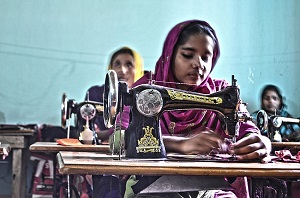
However, the move to cheaper locations like China has seen companies like Adidas criticised for allowing poor working conditions in the factories of some of their contract manufacturers (there is no suggestion that Yue Yuen is such a supplier - its workers are paid around $ ISO a month in cash and non-cash benefits - above average for the region). But the criticism has put pressure on the likes of Adidas, Nike and Reebok to monitor manufacturing more closely. Adidas is the only one out of the big three sports goods companies to have no public code of conduct for the treatment of workers by third party suppliers. Reebok has its Human Rights Production Standards and Nike has a code of conduct, subject to audit by Ernst & Young, that it signs in a memorandum of understanding with suppliers. These codes include provisions for health and safety, overtime pay, minimum age, insurance and freedom of association. Last year, the Londonbased charity Christian Aid asked Adidas to comment on the sacking of 760 workers by the Payavit Rubber Industry company -a supplier based in Bangkok, Thailand. The workers were given no notice or compensation for their dismissal. The charity says Adidas has so far not responded on this case. The company claims it has replied saying it is keen to see local laws upheld in any country in which it produces.
This is not the first time the publicity-shy company has courted controversy in Asia though. In November I996, Michel Perraudin, the member of Adidas' board responsible for restructuring projects, human resources and investor relations, represented his company at a meeting in London of the World Federation of the Sporting Goods Industry (WFSGI). The meeting followed press revelations that child labour had been used by a manufacturer in Sialkot, Pakistan that was making footballs under contract to Adidas and other western sports goods companies. Perraudin admitted that Adidas' supplier control mechanisms, run out of its Hong Kong regional office and local liaison offices throughout Asia, had failed on this occasion. This was because the Pakistani ball manufacturers had been forced to contract out work to private individuals at home to cope with demand for souvenir balls for the Euro 96 soccer tournament.
Pressure groups, though well-meaning, can often jump to false conclusions, says Csanadi. He gives an example of a video tape that was allegedly made by such a group in I995 of child labour in Pakistan. The products in the film had been discontinued by Adidas in I993. This suggested it was a counterfeiting operation.
For Asia, which now accounts for more than 80% of footwear and almost 60% of apparel, the company's need for close management of outsourcing has grown. Back in I987, shortly before the death of Horst Dassler (son of Adi), less than 65% of footwear was sourced in Asia, while the proportion of Asian-made apparel was similar to today. Since I994 the company has had a 100-person sourcing management team in Hong Kong, dealing with buying, logistics and quality control. Hong Kong's location in a central time zone for Asia Pacific makes it easier for the company to administer a further 500 staff at liaison offices in countries in which Adidas sources products. The company also set up a similar but smaller Latin American office in Panama. Csanadi says Latin American operations tend to be geared to local markets such as Peru where there are tough import restrictions. Latin America as a whole contributes less than 1% to Adidas' inter-regional sales.
Louis-Dreyfus has also forced through an about-turn in the company's r&d locations. In I993, weeks before she left, Beaux had bullishly promoted Adidas' newly-formed innovation group, including an r&d centre in Lucerne, Switzerland. But Louis-Dreyfus has been desperate to increase Adidas' share of the north American market (only 5% by I995). By I994 he decided the Lucerne centre was not only too expensive but also too far removed from north Americans' sporting tastes. The result was that he set up a biomechanics research centre and a regional marketing centre in Portland, Oregon in the US, while materials research was consolidated in Scheinfeld in Germany. The American predilection for adventure sports made Portland, says Csanadi somewhat enigmatically, a natural site for biomechanics research as did its "proximity" (9OOkm!) to Calgary in Canada, where the university has a reputable biomechanics institute. But Oregon is also close to - and considerably cheaper than - California, the epicentre of the US fitness market.
As far as Louis-Dreyfus is concerned, the brand name is what will drive Adidas forward. Unlike his counterparts at Nike and Reebok, he has managed a restructuring under a very low media profile as far as manufacturing is concerned commentators have been preoccupied with the success of the company's flotation in I995. There is no doubting the commercial sense of producing where labour costs are cheap but whether the subcontracting route is the right way to go is open to debate. The child labour controversy in Pakistan has already prompted Reebok to make a direct investment in its own factory there.