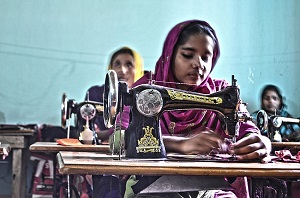
Toys can damage workers' health

(International Union Rights, vol.4 Issue 3, 1997)

Since February of this year, over 1000 workers at the Keyhinge toys factory in Vietnam have been struggling for the rights to the minimum wage and legal working hours, overtime pays, the right to organize and bargain collectively and improvements in healt and safety conditions. So far they have been unsuccessful in gaining even basic improvements in wages and working conditions to meet the requirements of the Labour Code.

Background

Keyhinge Toys (Vietnam) Co. is located in the Hoa Khanh Industrial Zone in Hoa Vang District, Quang Nam-Da Nang Province, Vietnam. The factory is a 100 per cent fogeign-owned plant established by Keyhinge Industrial Co. of Hong Kong in March 1996 with legal capital of US$14 million. In addition to the 25 year licence by the Vietnamese Government, Keyhinge Toys benefits from being located in an Industrial Zone.
The Keyhinge Toys factory produces givaway toys for McDonald's Restaurant Ltd, a well-known fast-food multinational. The Hong Kong company Keyhinge Industrial Co. wqas subcontracted by an American company called M-B Sales to produce McDonald's toys. In this sense Keyhinge is a subcontractor of M-B Sales which is a supplier to McDonald's.
M-B Sales also manages the subcontracting-out of McDonald's toy production to factories in China. Working conditions at these factories in China are extremely bad. In January 1992, 23 workers at the Chi Wah Toy factory in Zhuhai were sent to hospital following benzene poisoning. Three workers died. It was reported that the level of benzene was nine times higher than the maximum level permitted by law.
At another two toy factories in China producing for McDonald's, Kam Yuen Toys factory in Shenzhen and Sewco Toys factory in Zhongshan (also managed by M-B Sales), several workers were victims of chemical poisoning. Workers suffering injury or illness were not compensated, and the management violated a number of labour laws, including regulations on minimum wages and overtime pay, working hours (14-15 hours per day with no day off) and illegally retained-workers' first month's pay as a deposit.

Working conditions

Over 90 per cent of the workers at Keyhinge Toys are young women, most of them aged between 17 and 20 years old. For many of the workers this is their first job, and they lack the experience-needed to collectively defend their rights. Nearly all of them come from villages outside of Quang Nam-Da Nang Province, so they lack a social support base in or near the Hoa Khanh Industrial Zone.
The working day ay Keyhinge Toys is 10 hours, with no day off. Despite official regulations on working hours and overtime pay, work in excess of eight hours and work on Sundays is not treated as overtime.
Wages are extremely low at Keyhinge Toys. It was recently reported in the newspaper Lao Dong (Labour), that workers are earning as little as 1000 dong (US$0.08) per hour. This falls below the legal minimum wage of US$35 per month for workers in foreign enterprises outside of Hanoi and Ho Chi Minh City. The legal minimum wage of workers in Hanoi and Ho Chi Minh City is US$50).
Many workers are only paid the apprenticeship salary of 200.000 dong per month, or 700 dong (US$0.06) per hour, even after their three month probation period has ended. This is less than the legal minimum wage and violates labour regulations on apprenticeships. In a further violation of Labour Code, the management failed to provide the workers with employment contracts.
These wages fall well below a reasonable "living wage" for workers in this industrial district. Based on the cost of meals, accomodation, and local transport costs, living expences for one monthare around US$65. This does not even include money which can be saved or sent back to their fgamilies in their hometowns or villages.
The living costs of the workers are also affected by the canteen system in the factory. The meals provided in the factory are over-priced and inadequte. So workers are forced to eat outside and pay for meals themselves.

Punishment and unfair dismissal

Workers complained that in addition to low wages, security and discipline at the factory is very strict. Fines and penalties, including corporal punishment, are regularly imposed on the workers. However, they are not able to complain about these practices because they are easily dismissed.
The use of dismissal to threaten the workers is reflected in the sacking of 200 workers on February 22, 1997. Although the workers who were dismissed were not the same as those affected by acetone poisoning the day before (see below), it is likely that the management was randomly punishing the workers for the dispute which followed the poisoning incident.
As workers were entering the factory on the morning of February 22,200 or them had their passes taken away at the gate and were denied entry. Workers refused to go home and demanded that they be allowed in to work.
The next day an inspection team, including officials from the General Confederation of Labour, the City Labour Federation and the Department of Labour, went to the factory to resolve the dispute. The inspection team found that the workers had been illegally dismissed and ordered the management to reinstate the sacked workers. In response, the deputy director of Keyhinge Toys, Chen Wei Qing, claimed that there was a misunderstanding and that the workers had been sent home "temporarily". The management then promised that the workers could resume work on March 6.
Since Keyhinge had violated the labour law the inspection team ordered that wages be paid in full-for the two weeks the workers were illegally dismissed. On February 24, the management allowed 150 workers back to work and promised that the other 50 could start work again on March 6 However, by March 30 it still could not be confirmed whether all 200 workers were re-instated. Although the immediate problem of unfair dismissal was partly resolved, workers are still paid less than the minimum wage and are constantly threatened with dismissal Ultimately there have been no changes to working conditions, working hours or abusive management practices involving corporal punishment, intimidation and fines.

Acetone poisoning

On February 21, 1997, 220 workers at the Keyhinge factory became seriously ill and were forced to stop work as a result of acetone poisoning and overwork 25 workers collapsed and three were admitted to hospital for emergency medical treatment after falling unconscious.
It was found that workers were exposed to high amounts of acetone pollution in the air. In particular, the workers employed in the painting section of the toy factory are exposed to extremely high levels of acetone.
The workers affected by acetone poisoning received no compensation and the company failed to pay the medical costs of the three workers admitted to hospital. After the poisoning incident it was found that Keyhinge had failed to provide medical insurance as required by law.
In response to the incident, the Scientific & Technical ( Centre for Labour Protection (STCLP) in Da Nang City offered to assist Keyhinge Toys in designing and installing an appropriate ventilation system to reduce the level of acetone air pollution in the factory. The management refused to cooperate with STCLP. STCLP is one of two sub-institutes of the National Institute for Labour Protection (NILP), which is the major occupational health and safety body organised under the Vietnam General Confederation of Labour. At the beginning of March, the occupational health and safety specialists at STCLP made a second offer to work together to safeguard the health of workers, but the Hong Kong director, Yun Pun-Cheng, again refused. As a result the Keyhinge workers continue to be exposed to a dangerously high concentration of acetone.

The campaign in Hong Kong

At the beginning of April 1997, a campaign was launched in Hong Kong by the Coalition for the Charter On the Safe Production of Toys to place pressure on McDonald's and to raise public awareness of the serious violations of workers' rights and poor health and safety record of the McDonald's toy suppliers in Vietnam and China.
In the case of Keyhinge Toys in Vietnam, labour NGOs and trade unions are demanding that the following measures be taken to improve working conditions and bring an end to these serious violations of workers' rights: McDonald's Restaurants Ltd in Hong Kong responded to the campaign by claiming that M-B Sales is responsible for problems in factories producing McDonald's toys in China and Vietnam. So on April 17, a meeting was held with M-B Sales in Hong Kong to discuss the labour rights violations and poor working conditions in the factories of its subcontractors. However, the meeting produced no positive results, so the Coalition continued to demand that McDonald's take responsibility for the labour practices of its subcontractor and the conditions under which its toys are made.
Specifically, the Coalition is demanding that McDonald's adopt the Charter for the Safe Production of Toys and work with the Coalition in establishing an independent monitoring system to enforce the Charter in the factories of its suppliers and subcontractors. At the same time, the Coalition has been raising public awareness of the Keyhinge case and the problems faced by McDonald's toy factory workers in China through NGOs and trade unions overseas and the mass media.

Please send protest letters to:
James R Cantalupo, President, McDonald's Corp,
1 McDonald's Plaza,
Oakbrook, IL 60521, USA
Fax: +1-630-6237409

Mr. Al Aguilara, President, M-B Sales,
918 North Ashland Avenue,
Chicago, IL 60622, USA
Tel: +1-312-829-0045

For more information contact:

Gerard Greenfield
Asia Monitor Resource Center
444 Nathan Road, 8B
Kowloon, Hong Kong
Fax: (+852) 2385 5319
email: amrc@hk.super.net International Union Rights is available from: UCATT House, 177 Abbeville Rd., London Swa 9RL, UK


home page (3 k) Home page